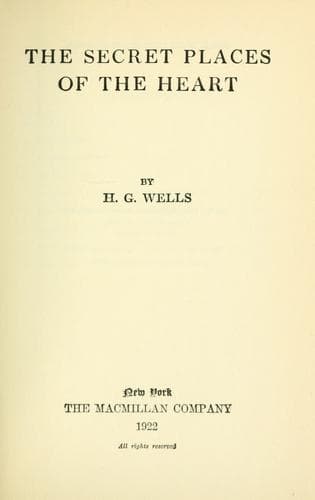
The Secret Places of the HeartWells, H. G. (Herbert George)
General
The Secret Places of the Heart
Wells, H. G. (Herbert George)
England -- Fiction; Man-woman relationships -- Fiction; Psychological fiction
This latter idea had reft her suddenly at the age of seventeen from
the educational care of an English gentlewoman warranted to fit her for
marriage with any prince in Europe, and thrust her for the mornings and
a moiety of the afternoons of the better part of a year, after a swift
but competent training, into a shirt waist and an office down town. She
had been entrusted at first to a harvester concern independent of Mr.
Grammont, because he feared his own people wouldn’t train her hard. She
had worked for ordinary wages and ordinary hours, and at the end of the
day, she mentioned casually, a large automobile with two menservants
and a trustworthy secretary used to pick her out from the torrent of
undistinguished workers that poured out of the Synoptical Building. This
masculinization idea had also sent her on a commission of enquiry into
Mexico. There apparently she had really done responsible work.
But upon the question of labour Mr. Grammont was fierce, even for an
American business man, and one night at a dinner party he discovered
his daughter displaying what he considered an improper familiarity
with socialist ideas. This had produced a violent revulsion towards the
purdah system and the idea of a matrimonial alliance with Gunter Lake.
Gunter Lake, Sir Richmond gathered, wasn’t half a bad fellow. Generally
it would seem Miss Grammont liked him, and she had a way of speaking
about him that suggested that in some way Mr. Lake had been rather
hardly used and had acquired merit by his behaviour under bad treatment.
There was some story, however, connected with her war services in Europe
upon which Miss Grammont was evidently indisposed to dwell. About that
story Sir Richmond was left at the end of his Avebury day and after his
last talk with Dr. Martineau, still quite vaguely guessing.
So much fact about Miss Grammont as we have given had floated up in
fragments and pieced itself together in Sir Richmond’s mind in the
course of a day and a half. The fragments came up as allusions or by way
of illustration. The sustaining topic was this New Age Sir Richmond
fore shadowed, this world under scientific control, the Utopia of fully
developed people fully developing the resources of the earth. For a
number of trivial reasons Sir Richmond found himself ascribing the
project of this New Age almost wholly to Dr. Martineau, and presenting
it as a much completer scheme than he was justified in doing. It was
true that Dr. Martineau had not said many of the things Sir Richmond
ascribed to him, but also it was true that they had not crystallized out
in Sir Richmond’s mind before his talks with Dr. Martineau. The idea of
a New Age necessarily carries with it the idea of fresh rules of conduct
and of different relationships between human beings. And it throws
those who talk about it into the companionship of a common enterprise.
To-morrow the New Age will be here no doubt, but today it is the hope
and adventure of only a few human beings.
Public-domain text, read in full here on John Shaqi.
Reviews
Reviews
No reviews yet
Be the first to share your thoughts on this work.
Elsewhere in the archive
Join the Discussion
Join the discussion
Sign in to leave a comment or review.
Sign InorCreate an account