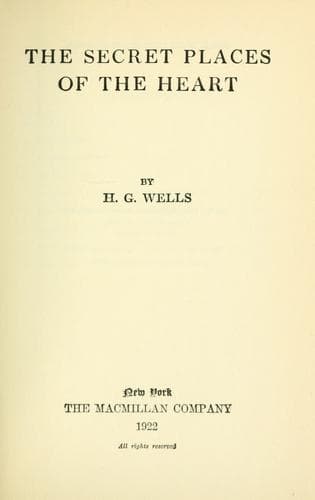
The Secret Places of the HeartWells, H. G. (Herbert George)
General
The Secret Places of the Heart
Wells, H. G. (Herbert George)
England -- Fiction; Man-woman relationships -- Fiction; Psychological fiction
“But England takes an American memory back most easily and most
fully--to Avebury and the Baltic Northmen, past the emperors and the
Corinthian columns that smothered Latin Europe.... For you and me anyhow
this is our past, this was our childhood, and this is our land.” He
interrupted laughing as she was about to reply. “Well, anyhow,” he said,
“it is a beautiful day and a pretty country before us with the ripest
history in every grain of its soil. So we’ll send a wire to your London
people and tell them to send their instructions to Wells.”
“I’ll tell Belinda,” she said, “to be quick with her packing.”
Section 7
As Miss Grammont and Sir Richmond Hardy fulfilled the details of his
excellent programme and revised their impressions of the past and their
ideas about the future in the springtime sunlight of Wiltshire and
Somerset, with Miss Seyffert acting the part of an almost ostentatiously
discreet chorus, it was inevitable that their conversation should
become, by imperceptible gradations, more personal and intimate. They
kept up the pose, which was supposed to represent Dr. Martineau’s
philosophy, of being Man and Woman on their Planet considering its
Future, but insensibly they developed the idiosyncrasies of their
position. They might profess to be Man and Woman in the most general
terms, but the facts that she was the daughter not of Everyman but old
Grammont and that Sir Richmond was the angry leader of a minority upon
the Fuel Commission became more and more important. “What shall we do
with this planet of ours?” gave way by the easiest transitions to “What
are you and I doing and what have we got to do? How do you feel about it
all? What do you desire and what do you dare?”
It was natural that Sir Richmond should talk of his Fuel Commission to
a young woman whose interests in fuel were even greater than his own.
He found that she was very much better read than he was in the recent
literature of socialism, and that she had what he considered to be a
most unfeminine grasp of economic ideas. He thought her attitude
towards socialism a very sane one because it was also his own. So far as
socialism involved the idea of a scientific control of natural resources
as a common property administered in the common interest, she and he
were very greatly attracted by it; but so far as it served as a form of
expression for the merely insubordinate discontent of the many with
the few, under any conditions, so long as it was a formula for class
jealousy and warfare, they were both repelled by it. If she had had any
illusions about the working class possessing as a class any profounder
political wisdom or more generous public impulses than any other class,
those illusions had long since departed. People were much the same, she
thought, in every class; there was no stratification of either rightness
or righteousness.
Public-domain text, read in full here on John Shaqi.
Reviews
Reviews
No reviews yet
Be the first to share your thoughts on this work.
Elsewhere in the archive
Join the Discussion
Join the discussion
Sign in to leave a comment or review.
Sign InorCreate an account