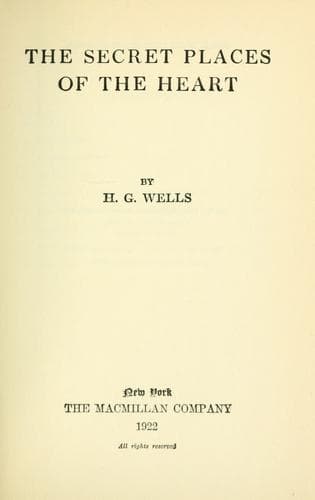
The Secret Places of the HeartWells, H. G. (Herbert George)
General
The Secret Places of the Heart
Wells, H. G. (Herbert George)
England -- Fiction; Man-woman relationships -- Fiction; Psychological fiction
“Oh!--Love of beauty, love of romance. I want to give things their
proper names; I don’t want to pretend to you.... It was more or less
than that.... It was--imaginative sensuousness. Why should I pretend it
wasn’t in me? I believe that streak is in all women.”
“I believe so too. In all properly constituted women.”
“I tried to devote that streak to Lake,” she said. “I did my best for
him. But Lake was much too much of a gentleman or an idealist about
women, or what you will, to know his business as a lover. And that side
of me fell in love, the rest of me protesting, with a man named Caston.
It was a notorious affair. Everybody in New York couples my name with
Caston. Except when my father is about. His jealousy has blasted an
area of silence--in that matter--all round him. He will not know of that
story. And they dare not tell him. I should pity anyone who tried to
tell it him.”
“What sort of man was this Caston?”
Miss Grammont seemed to consider. She did not look at Sir Richmond; she
kept her profile to him.
“He was,” she said deliberately, “a very rotten sort of man.”
She spoke like one resolved to be exact and judicial. “I believe I
always knew he wasn’t right. But he was very handsome. And ten years
younger than Lake. And nobody else seemed to be all right, so I
swallowed that. He was an artist, a painter. Perhaps you know his work.”
Sir Richmond shook his head. “He could make American business men look
like characters out of the Three Musketeers, they said, and he was
beginning to be popular. He made love to me. In exactly the way Lake
didn’t. If I shut my eyes to one or two things, it was delightful. I
liked it. But my father would have stood a painter as my husband almost
as cheerfully as he would a man of colour. I made a fool of myself, as
people say, about Caston. Well--when the war came, he talked in a way
that irritated me. He talked like an East Side Annunzio, about art and
war. It made me furious to know it was all talk and that he didn’t mean
business.... I made him go.”
She paused for a moment. “He hated to go.”
“Then I relented. Or I missed him and I wanted to be made love to. Or
I really wanted to go on my own account. I forget. I forget my motives
altogether now. That early war time was a queer time for everyone. A
kind of wildness got into the blood.... I threw over Lake. All the time
things had been going on in New York I had still been engaged to Lake.
I went to France. I did good work. I did do good work. And also things
were possible that would have seemed fantastic in America. You know
something of the war-time atmosphere. There was death everywhere and
people snatched at gratifications. Caston made ‘To-morrow we die’ his
text. We contrived three days in Paris together--not very cleverly. All
sorts of people know about it.... We went very far.”
She stopped short. “Well?” said Sir Richmond.
“He did die....”
Public-domain text, read in full here on John Shaqi.
Reviews
Reviews
No reviews yet
Be the first to share your thoughts on this work.
Elsewhere in the archive
Join the Discussion
Join the discussion
Sign in to leave a comment or review.
Sign InorCreate an account