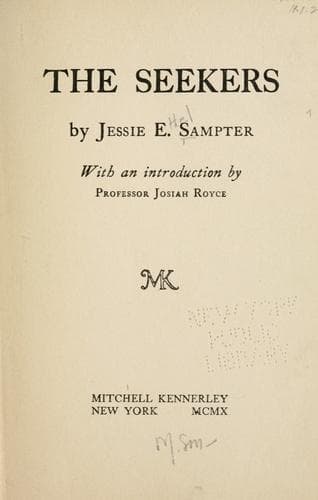
Philosophy and religion -- Study and teaching (Secondary) -- United States
Marian spoke of people she liked, but could not respect.
“If you knew them from the inside,” I said, “as they know themselves,
you might feel otherwise.”
“Yes,” said Virginia, “I have always thought that if anybody knew all
about me, knew me just as I know myself, they could not help liking me.”
I said: “It seems not much to expect of us, to understand our parents,
who are so anxious for an understanding, and whom we love. After all, we
do owe them something—when you consider that but for them we would not
be here; and we are most of us rather glad that we are here.”
“Yes,” said Marian, “I would like to stay a while longer.”
Now we spoke of many things, many personal things, of quarrels and how
to avoid them. Virginia amused us by saying people often quarreled with
her, but she never quarreled with them.
Marian said: “If there’s one thing which makes people feel mean, angry,
self-reproachful and small, it is to try to quarrel with some one who
won’t be made angry.”
“Naturally,” I said, “they can’t help comparing themselves with the
other person.”
“Yes,” said Florence, “I am always sorry and angry at myself when the
other person keeps cool or is hurt. But when the other person gets
angry, too, I feel as if I were right.”
“It’s an ugly thing to be angry,” I said; “it makes us so small, shuts
us in.”
“How do you mean?” asked Marian.
“It cuts us off from that other person, makes it impossible to
understand at least him, and so keeps us from completeness and harmony,
actually robs us of part of ourself.”
Was it all the children’s fault, they asked, when children and parents
failed to understand each other?
“As it takes two to make a quarrel,” I answered, “so it takes two to
make a misunderstanding. But _one_ can stop it. Remember that older
people have often gone through trials in life that have shaken their
nerves and made them sensitive and irritable to little annoyances.”
Marian asked: “Do you mean fussy?”
“Yes,” I said, “and it is easy to understand. But the fact that in many
families some of the children get along well with the parents, and
others do not, proves that at least some of the responsibility rests
with the children.”
Public-domain text, read in full here on John Shaqi.
Reviews
Reviews
No reviews yet
Be the first to share your thoughts on this work.
Elsewhere in the archive
Join the Discussion
Join the discussion
Sign in to leave a comment or review.
Sign InorCreate an account