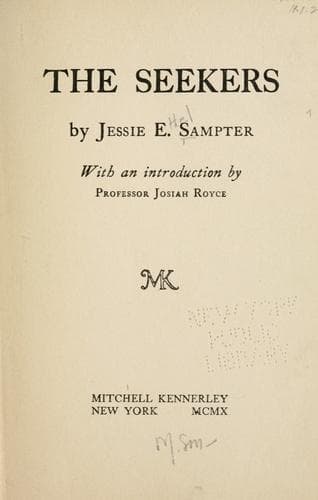
Philosophy and religion -- Study and teaching (Secondary) -- United States
“You mean that you have to do disagreeable things to get what you want.
Naturally. That is self-sacrifice. And you cannot always do things as
you would like to do them. The woman in the house might find ugly
wallpaper, and not be able to change that. But she would find other
means of making things look better. People can have conscious influence;
and the difference between those who make life good and beautiful, and
those who attract attention to themselves, is the difference between the
play in which all the actors are good, and combine to make a beautiful
play, and the one where there is a star who wants a poor cast to set off
her charms, and produces an inartistic and uneven play.”
“I don’t see how one could have conscious influence,” said Marian; “it
seems to me one lives unconsciously all the time. I like to dream. I am
not fond of acting. I don’t believe I would ever have any conscious
influence.”
“To dream and dream and keep on dreaming, and not act, is impossible,” I
said.
“But,” asked Florence, “isn’t it just the dreamers who do all the great
things?”
“Surely,” I answered, “one cannot help influencing people, even by one’s
dreams. But you, Florence, you must realize how much difference each
member of a family makes.”
“Yes, I do.”
“And Virginia, I believe, has often made conscious effort toward
cheerful influence, and knows what I mean. You, too, Ruth; I am certain
you know exactly what I mean, and I hope you and Marian will talk it
over; for it is an interesting subject.”
“Yes, I know well what you mean.”
As we left I asked Alfred to write a paper for me. “For,” I said, “they
will begin to think you stupid if you show no sign of intelligence. And
even I would like a tangible proof of what I really know, that you do
grasp exactly the spirit of what we say.”
THIRTEENTH MEETING
Marian was absent. I read aloud Henry’s paper:
“Last Sunday we met for the first time in almost two months. We had
finished talking about art, and we started on a new course in which we
shall apply our standard of beauty.
“Our topic last Sunday was Goodness. Good is a much-abused word. We
often speak disdainfully of a person, as being a goody-goody, but
usually this person, though not necessarily bad, is not good according
to the standard of to-day. In the last generation, and even in some
places to-day, the good child is the one which does its work
conscientiously, and spends all its spare time at sewing or doing odd
jobs around the house. The ‘good man’ does his work faithfully, never
swears or lies under any circumstances, and follows his religion, as it
is set down for him by others, absolutely to the letter.
Public-domain text, read in full here on John Shaqi.
Reviews
Reviews
No reviews yet
Be the first to share your thoughts on this work.
Elsewhere in the archive
Join the Discussion
Join the discussion
Sign in to leave a comment or review.
Sign InorCreate an account