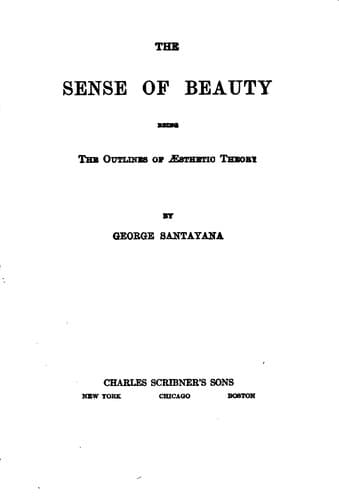
The Sense of Beauty: Being the Outlines of Aesthetic TheorySantayana, George
Philosophy
The Sense of Beauty: Being the Outlines of Aesthetic Theory
Santayana, George
Aesthetics
Sec. 43. The known impossibility of adequate translation appears here
at the basis of language. The other diversities are superadded upon
this diversity of sound. The syntax is the next source of effect.
What could be better than Homer, or what worse than almost any
translation of him? And this holds even of languages so closely
allied as the Indo-European, which, after all, have certain
correspondences of syntax and inflection. If there could be a
language with other parts of speech than ours, -- a language
without nouns, for instance, -- how would that grasp of experience,
that picture of the world, which all our literature contains, be
reproduced in it? Whatever beauties that language might be
susceptible of, none of the effects produced on us, I will not say by
poets, but even by nature itself, could be expressed in it.
Nor is such a language inconceivable. Instead of summarizing all
our experiences of a thing by one word, its name, we should have
to recall by appropriate adjectives the various sensations we had
received from it; the objects we think of would be disintegrated, or,
rather, would never have been unified. For "sun," they would say
"high, yellow, dazzling, round, slowly moving," and the
enumeration of these qualities (as we call them), without any
suggestion of a unity at their source, might give a more vivid, and
profound, if more cumbrous, representation of the facts. But how
could the machinery of such an imagination be capable of
repeating the effects of ours, when the objects to us most obvious
and real would be to those minds utterly indescribable?
The same diversity appears in the languages we ordinarily know,
only in a lesser degree. The presence or absence of case-endings in
nouns and adjectives, their difference of gender, the richness of
inflections in the verbs, the frequency of particles and conjunctions,
-- all these characteristics make one language differ from another
entirely in genius and capacity of expression. Greek is probably the
best of all languages in melody, richness, elasticity, and simplicity;
so much so, that in spite of its complex inflections, when once a
vocabulary is acquired, it is more easy and natural for a modern
than his ancestral Latin itself. Latin is the stiffer tongue; it is by
nature at once laconic and grandiloquent, and the exceptional
condensation and transposition of which it is capable make its
effects entirely foreign to a modern, scarcely inflected, tongue.
Take, for instance, these lines of Horace:
me tabula sacer
votiva paries indicat uvida
suspendisse potenti
vestimenta maris deo,
or these of Lucretius:
Jauaque caput quassans grandis suspirat arator
Crebrius incassum magnum cecidisse laborem.
What conglomerate plebeian speech of our time could utter the
stately grandeur of these Lucretian words, every one of which is
noble, and wears the toga?
Public-domain text, read in full here on John Shaqi.
Reviews
Reviews
No reviews yet
Be the first to share your thoughts on this work.
Elsewhere in the archive
Join the Discussion
Join the discussion
Sign in to leave a comment or review.
Sign InorCreate an account