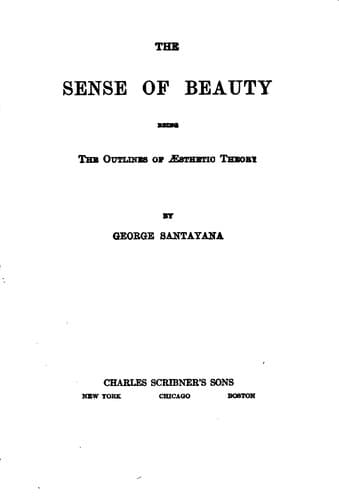
The Sense of Beauty: Being the Outlines of Aesthetic TheorySantayana, George
Philosophy
The Sense of Beauty: Being the Outlines of Aesthetic Theory
Santayana, George
Aesthetics
The Virgin Mary, whose legend is so meagre, but whose power
over the Catholic imagination is so great, is an even clearer
illustration of this inward building up of an ideal form. Everything
is here spontaneous sympathetic expansion of two given events:
the incarnation and the crucifixion. The figure of the Virgin, found
in these mighty scenes, is gradually clarified and developed, until
we come to the thought on the one hand of her freedom from
original sin, and on the other to that of her universal maternity. We
thus attain the conception of one of the noblest of conceivable
roles and of one of the most beautiful of characters. It is a pity that
a foolish iconoclasm should so long have deprived the Protestant
mind of the contemplation of this ideal.
Perhaps it is a sign of the average imaginative dulness or fatigue of
certain races and epochs that they so readily abandon these
supreme creations. For, if we are hopeful, why should we not
believe that the best we can fancy is also the truest; and if we are
distrustful in general of our prophetic gifts, why should we cling
only to the most mean and formless of our illusions? From the
beginning to the end of our perceptive and imaginative activity, we
are synthesizing the material of experience into unities the
independent reality of which is beyond proof, nay, beyond the
possibility of a shadow of evidence. And yet the life of intelligence,
like the joy of contemplation, lies entirely in the formation and
inter-relation of these unities. This activity yields us all the objects
with which we can deal, and endows them with the finer and more
intimate part of their beauty. The most perfect of these forms,
judged by its affinity to our powers and its stability in the presence
of our experience, is the one with which we should be content; no
other kind of veracity could add to its value.
The greatest feats of synthesis which the human mind has yet
accomplished will, indeed, be probably surpassed and all ideals yet
formed be superseded, because they were not based upon enough
experience, or did not fit that experience with adequate precision.
It is also possible that changes in the character of the facts, or in
the powers of intelligence, should necessitate a continual
reconstruction of our world. But unless human nature suffers an
inconceivable change, the chief intellectual and aesthetic value of
our ideas will always come from the creative action of the
imagination.
PART IV
EXPRESSION
_Expression defined._
Public-domain text, read in full here on John Shaqi.
Reviews
Reviews
No reviews yet
Be the first to share your thoughts on this work.
Elsewhere in the archive
Join the Discussion
Join the discussion
Sign in to leave a comment or review.
Sign InorCreate an account