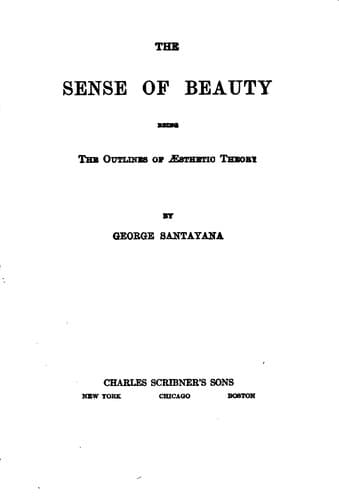
The Sense of Beauty: Being the Outlines of Aesthetic TheorySantayana, George
Philosophy
The Sense of Beauty: Being the Outlines of Aesthetic Theory
Santayana, George
Aesthetics
The distinctness of the analysis may indeed be so great as to
prevent the synthesis; we may so entirely pass to the suggested
object, that our pleasure will be embodied in the memory of that,
while the suggestive sensation will be overlooked, and the
expressiveness of the present object will fail to make it beautiful.
Thus the mementos of a lost friend do not become beautiful by
virtue of the sentimental associations which may make them
precious. The value is confined to the images of the memory; they
are too clear to let any of that value escape and diffuse itself over
the rest of our consciousness, and beautify the objects which we
actually behold. We say explicitly: I value this trifle for its
associations. And so long as this division continues, the worth of
the thing is not for us aesthetic.
But a little dimming of our memory will often make it so. Let the
images of the past fade, let them remain simply as a halo and
suggestion of happiness hanging about a scene; then this scene,
however empty and uninteresting in itself, will have a deep and
intimate charm; we shall be pleased by its very vulgarity. We shall
not confess so readily that we value the place for its associations;
we shall rather say: I am fond of this landscape; it has for me an
ineffable attraction. The treasures of the memory have been melted
and dissolved, and are now gilding the object that supplants them;
they are giving this object expression.
Expression then differs from material or formal value only as habit
differs from instinct -- in its origin. Physiologically, they are both
pleasurable radiations of a given stimulus; mentally, they are both
values incorporated in an object. But an observer, looking at the
mind historically, sees in the one case the survival of an experience,
in the other the reaction of an innate disposition. This experience,
moreover, is generally rememberable, and then the extrinsic source
of the charm which expression gives becomes evident even to the
consciousness in which it arises. A word, for instance, is often
beautiful simply by virtue of its meaning and associations; but
sometimes this expressive beauty is added to a musical quality in
the world itself. In all expression we may thus distinguish two
terms: the first is the object actually presented, the word, the image,
the expressive thing; the second is the object suggested, the further
thought, emotion, or image evoked, the thing expressed.
Public-domain text, read in full here on John Shaqi.
Reviews
Reviews
No reviews yet
Be the first to share your thoughts on this work.
Elsewhere in the archive
Join the Discussion
Join the discussion
Sign in to leave a comment or review.
Sign InorCreate an account