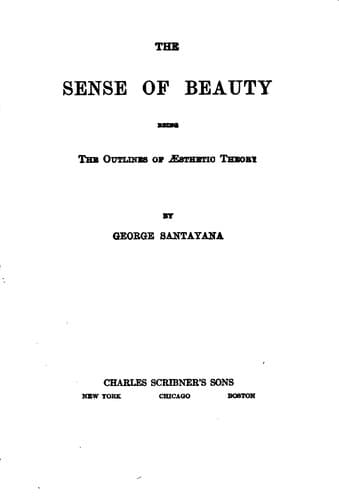
The Sense of Beauty: Being the Outlines of Aesthetic TheorySantayana, George
Philosophy
The Sense of Beauty: Being the Outlines of Aesthetic Theory
Santayana, George
Aesthetics
Truth is thus the excuse which ugliness has for being. Many people,
in whom the pursuit of knowledge and the indulgence in sentiment
have left no room for the cultivation of the aesthetic sense, look in
art rather for this expression of fact or of passion than for the
revelation of beauty. They accordingly produce and admire works
without intrinsic value. They employ the procedure of the fine arts
without an eye to what can give pleasure in the effect. They invoke
rather the _a priori_ interest which men are expected to have in the
subject-matter, or in the theories and moral implied in the
presentation of it. Instead of using the allurements of art to inspire
wisdom, they require an appreciation of wisdom to make us endure
their lack of art.
Of course, the instruments of the arts are public property and any
one is free to turn them to new uses. It would be an interesting
development of civilization if they should now be employed only
as methods of recording scientific ideas and personal confessions.
But the experiment has not succeeded and can hardly succeed.
There are other simpler, clearer, and more satisfying ways of
expounding truth. A man who is really a student of history or
philosophy will never rest with the vague and partial oracles of
poetry, not to speak of the inarticulate suggestions of the plastic
arts. He will at once make for the principles which art cannot
express, even if it can embody them, and when those principles are
attained, the works of art, if they had no other value than that of
suggesting them, will lapse from his mind. Forms will give place
to formulas as hieroglyphics have given place to the letters of the
alphabet.
If, on the other hand, the primary interest is really in beauty, and
only the confusion of a moral revolution has obscured for a while
the vision of the ideal, then as the mind regains its mastery over the
world, and digests its new experience, the imagination will again
be liberated, and create its forms by its inward affinities, leaving
all the weary burden, archaeological, psychological, and ethical, to
those whose business is not to delight. But the sudden inundation
of science and sentiment which has made the mind of the
nineteenth century so confused, by overloading us with materials
and breaking up our habits of apperception and our ideals, has led
to an exclusive sense of the value of expressiveness, until this has
been almost identified with beauty. This exaggeration can best
prove how the expression of truth may enter into the play of
aesthetic forces, and give a value to representations which, but for
it, would be repulsive.
_The liberation of self._
Public-domain text, read in full here on John Shaqi.
Reviews
Reviews
No reviews yet
Be the first to share your thoughts on this work.
Elsewhere in the archive
Join the Discussion
Join the discussion
Sign in to leave a comment or review.
Sign InorCreate an account