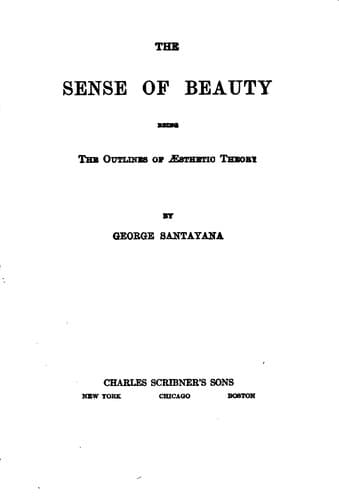
The Sense of Beauty: Being the Outlines of Aesthetic TheorySantayana, George
Philosophy
The Sense of Beauty: Being the Outlines of Aesthetic Theory
Santayana, George
Aesthetics
In the trite examples of the sublime, where we speak of the vast
mass, strength, and durability of objects, or of their sinister aspect,
as if we were moved by them on account of our own danger, we
seem to miss the point. For the suggestion of our own danger
would produce a touch of fear; it would be a practical passion, or if
it could by chance be objectified enough to become aesthetic, it
would merely make the object hateful and repulsive, like a
mangled corpse. The object is sublime when we forget our danger,
when we escape from ourselves altogether, and live as it were in
the object itself, energizing in imitation of its movement, and
saying, "Be thou me, impetuous one!" This passage into the object,
to live its life, is indeed a characteristic of all perfect contemplation.
But when in thus translating ourselves we rise and play a higher
personage, feeling the exhilaration of a life freer and wilder than
our own, then the experience is one of sublimity. The emotion
comes not from the situation we observe, but from the powers we
conceive; we fail to sympathize with the struggling sailors because
we sympathize too much with the wind and waves. And this
mystical cruelty can extend even to ourselves; we can so feel the
fascination of the cosmic forces that engulf us as to take a fierce
joy in the thought of our own destruction. We can identify
ourselves with the abstractest essence of reality, and, raised to that
height, despise the human accidents of our own nature. Lord, we
say, though thou slay me, yet will I trust in thee. The sense of
suffering disappears in the sense of life and the imagination
overwhelms the understanding.
_The comic._
Sec. 61. Something analogous takes place in the other spheres where
an aesthetic value seems to arise out of suggestions of evil, in the
comic, namely, and the grotesque. But here the translation of our
sympathies is partial, and we are carried away from ourselves only
to become smaller. The larger humanity, which cannot be absorbed,
remains ready to contradict the absurdity of our fiction. The
excellence of comedy lies in the invitation to wander along some
by-path of the fancy, among scenes not essentially impossible, but
not to be actually enacted by us on account of the fixed
circumstances of our lives. If the picture is agreeable, we allow
ourselves to dream it true. We forget its relations; we forbid the
eye to wander beyond the frame of the stage, or the conventions of
the fiction. We indulge an illusion which deepens our sense of the
essential pleasantness of things.
Public-domain text, read in full here on John Shaqi.
Reviews
Reviews
No reviews yet
Be the first to share your thoughts on this work.
Elsewhere in the archive
Join the Discussion
Join the discussion
Sign in to leave a comment or review.
Sign InorCreate an account