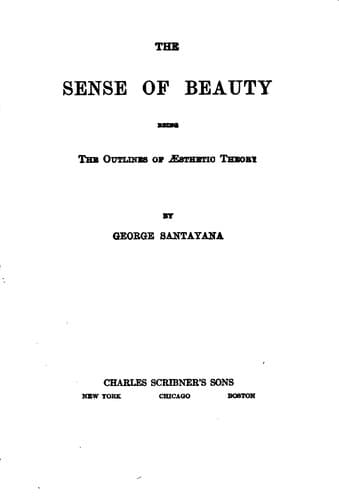
The Sense of Beauty: Being the Outlines of Aesthetic TheorySantayana, George
Philosophy
The Sense of Beauty: Being the Outlines of Aesthetic Theory
Santayana, George
Aesthetics
The juxtaposition of these two pleasures produces just that tension
and complication in which the humorous consists. We are satirical,
and we are friendly at the same time. The consciousness of the
friendship gives a regretful and tender touch to the satire, and the
sting of the satire makes the friendship a trifle humble and sad.
Don Quixote is mad; he is old, useless, and ridiculous, but he is the
soul of honour, and in all his laughable adventures we follow him
like the ghost of our better selves. We enjoy his discomfitures too
much to wish he had been a perfect Amadis; and we have besides a
shrewd suspicion that he is the only kind of Amadis there can ever
be in this world. At the same time it does us good to see the
courage of his idealism, the ingenuity of his wit, and the simplicity
of his goodness. But how shall we reconcile our sympathy with his
dream and our perception of its absurdity? The situation is
contradictory. We are drawn to some different point of view, from
which the comedy may no longer seem so amusing. As humour
becomes deep and really different from satire, it changes into
pathos, and passes out of the sphere of the comic altogether. The
mischances that were to amuse us as scoffers now grieve us as men,
and the value of the representation depends on the touches of
beauty and seriousness with which it is adorned.
_The grotesque._
Sec. 64. Something analogous to humour can appear in plastic forms,
when we call it the grotesque. This is an interesting effect
produced by such a transformation of an ideal type as exaggerates
one of its elements or combines it with other types. The real
excellence of this, like that of all fiction, consists in re-creation; in
the formation of a thing which nature has not, but might
conceivably have offered. We call these inventions comic and
grotesque when we are considering their divergence from the
natural rather than their inward possibility. But the latter
constitutes their real charm; and the more we study and develope
them, the better we understand it. The incongruity with the
conventional type than disappears, and what was impossible and
ridiculous at first takes its place among recognized ideals. The
centaur and the satyr are no longer grotesque; the type is accepted.
And the grotesqueness of an individual has essentially the same
nature. If we like the inward harmony, the characteristic balance of
his features, we are able to disengage this individual from the class
into which we were trying to force him; we can forget the
expectation which he was going to disappoint. The ugliness then
disappears, and only the reassertion of the old habit and demand
can make us regard him as in any way extravagant.
Public-domain text, read in full here on John Shaqi.
Reviews
Reviews
No reviews yet
Be the first to share your thoughts on this work.
Elsewhere in the archive
Join the Discussion
Join the discussion
Sign in to leave a comment or review.
Sign InorCreate an account