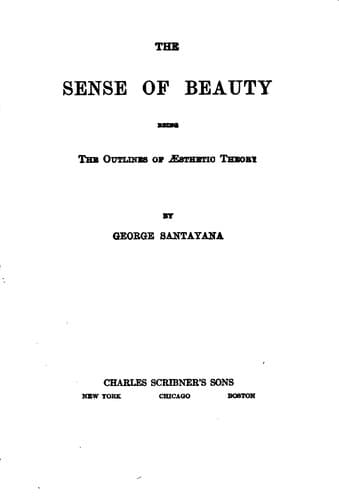
The Sense of Beauty: Being the Outlines of Aesthetic TheorySantayana, George
Philosophy
The Sense of Beauty: Being the Outlines of Aesthetic Theory
Santayana, George
Aesthetics
This incapacity of the imagination to reconstruct the conditions of
life and build the frame of things nearer to the heart's desire is
dangerous to a steady loyalty to what is noble and fine. We
surrender ourselves to a kind of miscellaneous appreciation,
without standard or goal; and calling every vexatious apparition by
the name of beauty, we become incapable of discriminating its
excellence or feeling its value. We need to clarify our ideals, and
enliven our vision of perfection. No atheism is so terrible as the
absence of an ultimate ideal, nor could any failure of power be
more contrary to human nature than the failure of moral
imagination, or more incompatible with healthy life. For we have
faculties, and habits, and impulses. These are the basis of our
demands. And these demands, although variable, constitute an
ever-present intrinsic standard of value by which we feel and judge.
The ideal is immanent in them; for the ideal means that
environment in which our faculties would find their freest
employment, and their most congenial world. Perfection would be
nothing but life under those conditions. Accordingly our
consciousness of the ideal becomes distinct in proportion as we
advance in virtue and in proportion to the vigour and definiteness
with which our faculties work. When the vital harmony is
complete, when the _act_ is _pure,_ faith in perfection passes into
vision. That man is unhappy indeed, who in all his life has had no
glimpse of perfection, who in the ecstasy of love, or in the delight
of contemplation, has never been able to say: It is attained. Such
moments of inspiration are the source of the arts, which have no
higher function than to renew them.
A work of art is indeed a monument to such a moment, the
memorial to such a vision; and its charm varies with its power of
recalling us from the distractions of common life to the joy of a
more natural and perfect activity.
_The stability of the ideal._
Sec. 66. The perfection thus revealed is relative to our nature and
faculties; if it were not, it could have no value for us. It is revealed
to us in brief moments, but it is not for that reason an unstable or
fantastic thing. Human attention inevitably flickers; we survey
things in succession, and our acts of synthesis and our realization
of fact are only occasional. This is the tenure of all our possessions;
we are not uninterruptedly conscious of ourselves, our physical
environment, our ruling passions, or our deepest conviction. What
wonder, then, that we are not constantly conscious of that
perfection which is the implicit ideal of all our preferences and
desires? We view it only in parts, as passion or perception
successively directs our attention to its various elements. Some of
us never try to conceive it in its totality. Yet our whole life is an act
of worship to this unknown divinity; every heartfelt prayer is
offered before one or another of its images.
Public-domain text, read in full here on John Shaqi.
Reviews
Reviews
No reviews yet
Be the first to share your thoughts on this work.
Elsewhere in the archive
Join the Discussion
Join the discussion
Sign in to leave a comment or review.
Sign InorCreate an account