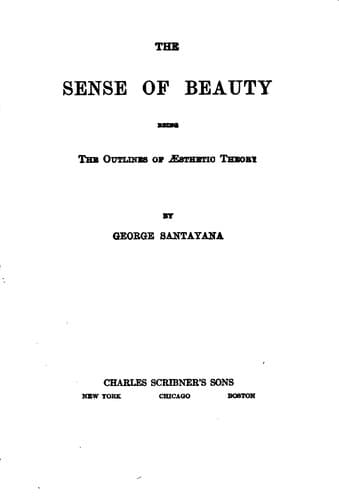
The Sense of Beauty: Being the Outlines of Aesthetic TheorySantayana, George
Philosophy
The Sense of Beauty: Being the Outlines of Aesthetic Theory
Santayana, George
Aesthetics
Hamlet, 179.
Happiness and aesthetic interest, 63, 65.
Health a condition of aesthetic life, 54.
Hedonism opposed by the moral sense, 23, 24.
History an imaginative thing, 141, 142.
Home as a social and as an aesthetic idea, 64.
Homer, 171.
his aesthetic quality, 205, 206.
his epithets, 179.
Horace, quoted, 172.
Humour, 253 _et seq._
Ideals are modified averages, 121 _et seq._
immanent in human nature, 262.
stable, 263 _et seq._
Imagination has a universal creative function, 190, 191.
and sense alternately active, 55, 56.
Impression distinguished from expression, 84, 85.
Impressionism in painting, 134, 136.
incongruity not what pleases in the comic, 247 _et seq._
Indeterminate organizational _et seq._
Infinite beauty, the idea impossible, 148 _et seq._
Inspiration, 252, 253.
Kalokagathia, 31.
Kant, 105.
Keats, quoted, 67, 105, 181, 264.
King Lear, 229.
Kipling, R., quoted, 68.
Landscape, 133 _et seq._
with figures, 135, 136.
Liberation of self, 233 _et seq._
Love, influence of the passion, 56 _et seq._
Lowell, J. R., quoted, 148.
Lower senses, 65 _et seq._
Lucretius, quoted, 172.
on the sublime, 236.
Maps, 209, 210.
Material beauty most easily appreciated, 78 _et seq._
its effect the fundamental one, 78.
Materials of beauty surveyed, 76 _et seq._
Methods in aesthetics, 5.
Michael Angelo, 182.
Miser's fallacy, its parallel in morals and aesthetics, 31, 32.
Modern languages inferior to the ancient, 173, 174.
Moliere, 174; quoted, 20.
Monarchy, its imaginative value, 34, 35.
Moral and aesthetic values, 23 _et seq._
the authority of morals over aesthetics, 218 _et seq._
Morality and utility jealous of art, 216, 217.
Multiplicity in uniformity, 97 _et seq._
its defects, 106 _et seq._
Musset, Alfred de, quoted, 170, 226.
Mysticism in aesthetics, 126 _et seq._
Naturalism, the ground of its value, 21.
Nature, its organization the source of apperceptive forms,
152 _et seq._
the love of it among the ancients, 137, 138.
New York, the plan of the streets, 95.
Nouns, idea of a language without them, 171.
Objectification the differentia of aesthetic pleasure, 44 _et seq._
Ornament and form, 63 _et seq._
Othello, 237.
Ovid, quoted, 149.
Pantheism, its contradictions, 242, 243.
Perception, the psychological theory of it, 45 _et seq._
Perfection, illusion of infinite, 146 _et seq._
possibility of finite, 258 _et seq._
Physical pleasure distinguished from aesthetic, 35 _et seq._
Physiology of the perception of form, 85 _et seq._
Picturesqueness contrasted with symmetry, 92.
Platonic ideas useless in explaining types, 117, 118.
Platonic intuitions, their nature and value, 8 _et seq._
Platonists, 159.
Plot, The, 174 _et seq._
Preference ultimately irrational, 18 _et seq._
necessary to value, 17, 18.
Principles consecrated aesthetically, 31 _et seq._
Purity, The aesthetic principle of, 70 _et seq._
Public-domain text, read in full here on John Shaqi.
Reviews
Reviews
No reviews yet
Be the first to share your thoughts on this work.
Elsewhere in the archive
Join the Discussion
Join the discussion
Sign in to leave a comment or review.
Sign InorCreate an account