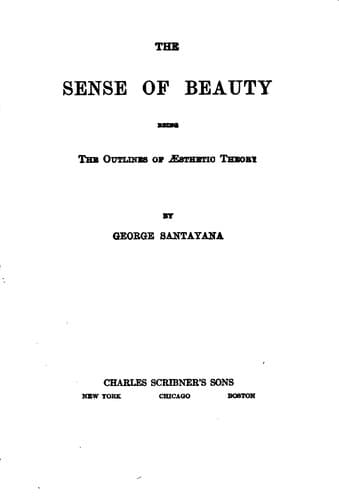
The Sense of Beauty: Being the Outlines of Aesthetic TheorySantayana, George
Philosophy
The Sense of Beauty: Being the Outlines of Aesthetic Theory
Santayana, George
Aesthetics
The pleasures, therefore, which a kindly but monotonous
environment produces, often fail to make it beautiful, for the
simple reason that the environment is not perceived. Likewise the
hideousness of things to which we are accustomed -- the blemishes
of the landscape, the ugliness of our clothes or of our walls -- do
not oppress us, not so much because we do not see the ugliness as
because we overlook the things. The beauties or defects of
monotonous objects are easily lost, because the objects are
themselves intermittent in consciousness. But it is of some
practical importance to remark that this indifference of
monotonous values is more apparent than real. The particular
object ceases to be of consequence; but the congruity of its
structure and quality with our faculties of perception remains, and
its presence in our environment is still a constant source of vague
irritation and friction, or of subtle and pervasive delight. And this
value, although not associated with the image of the monotonous
object, lies there in our mind, like all the vital and systemic
feelings, ready to enhance the beauty of any object that arouses our
attention, and meantime adding to the health and freedom of our
life -- making whatever we do a little easier and pleasanter for us.
A grateful environment is a substitute for happiness. It can quicken
us from without as a fixed hope and affection, or the consciousness
of a right life, can quicken us from within. To humanize our
surroundings is, therefore, a task which should interest the
physicians both of soul and body.
But the monotony of multiplicity is not merely intrinsic in the form;
what is perhaps even of greater consequence in the arts is the fact
that its capacity for association is restricted. What is in itself
uniform cannot have a great diversity of relations. Hence the
dryness, the crisp definiteness and hardness, of those products of
art which contain an endless repetition of the same elements. Their
affinities are necessarily few; they are not fit for many uses, nor
capable of expressing many ideas. The heroic couplet, now too
much derided, is a form of this kind. Its compactness and
inevitableness make it excellent for an epigram and adequate it for
a satire, but its perpetual snap and unvarying rhythm are thin for an
epic, and impossible for a song. The Greek colonnade, a form in
many ways analogous, has similar limitations. Beautiful with a
finished and restrained beauty, which our taste is hardly refined
enough to appreciate, it is incapable of development. The
experiments of Roman architecture sufficiently show it; the glory
of which is their Roman frame rather than their Hellenic ornament.
Public-domain text, read in full here on John Shaqi.
Reviews
Reviews
No reviews yet
Be the first to share your thoughts on this work.
Elsewhere in the archive
Join the Discussion
Join the discussion
Sign in to leave a comment or review.
Sign InorCreate an account