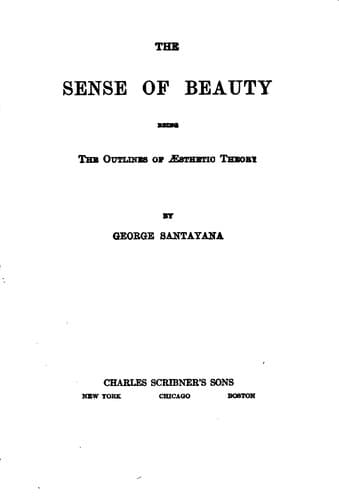
The Sense of Beauty: Being the Outlines of Aesthetic TheorySantayana, George
Philosophy
The Sense of Beauty: Being the Outlines of Aesthetic Theory
Santayana, George
Aesthetics
In the leading political and moral idea of our time, in the idea of
democracy, I think there is a strong aesthetic ingredient, and the
power of the idea of democracy over the imagination is an
illustration of that effect of multiplicity in uniformity which we
have been studying. Of course, nothing could be more absurd than
to suggest that the French Revolution, with its immense
implications, had an aesthetic preference for its basis; it sprang, as
we know, from the hatred of oppression, the rivalry of classes, and
the aspiration after a freer social and strictly moral organization.
But when these moral forces were suggesting and partly realizing
the democratic idea, this idea was necessarily vividly present to
men's thoughts; the picture of human life which it presented was
becoming familiar, and was being made the sanction and goal of
constant endeavour. Nothing so much enhances a good as to make
sacrifices for it. The consequence was that democracy, prized at
first as a means to happiness and as an instrument of good
government, was acquiring an intrinsic value; it was beginning to
seem good in itself, in fact, the only intrinsically right and perfect
arrangement. A utilitarian scheme was receiving an aesthetic
consecration. That which was happening to democracy had
happened before to the feudal and royalist systems; they too had
come to be prized in themselves, for the pleasure men took in
thinking of society organized in such an ancient, and thereby to
their fancy, appropriate and beautiful manner. The practical value
of the arrangement, on which, of course, it is entirely dependent for
its origin and authority, was forgotten, and men were ready to
sacrifice their welfare to their sense of propriety; that is, they
allowed an aesthetic good to outweigh a practical one. That seems
now a superstition, although, indeed, a very natural and even noble
one. Equally natural and noble, but no less superstitious, is our
own belief in the divine right of democracy. Its essential right is
something purely aesthetic.
Public-domain text, read in full here on John Shaqi.
Reviews
Reviews
No reviews yet
Be the first to share your thoughts on this work.
Elsewhere in the archive
Join the Discussion
Join the discussion
Sign in to leave a comment or review.
Sign InorCreate an account