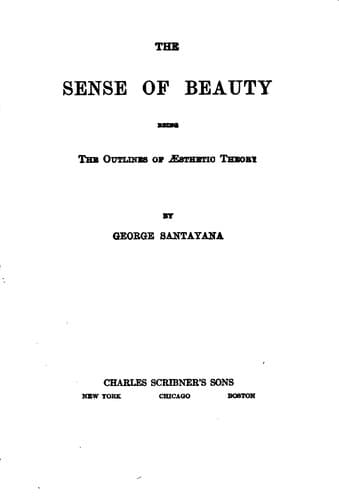
The Sense of Beauty: Being the Outlines of Aesthetic TheorySantayana, George
Philosophy
The Sense of Beauty: Being the Outlines of Aesthetic Theory
Santayana, George
Aesthetics
Sec. 31. These principles lead to an intelligible answer to a question
which is not uninteresting in itself and crucial in a system of
aesthetics. Are all things beautiful? Are all types equally beautiful
when we abstract from our practical prejudices? If the reader has
given his assent to the foregoing propositions, he will easily see
that, in one sense, we must declare that no object is essentially ugly.
If impressions are painful, they are objectified with difficulty; the
perception of a thing is therefore, under normal circumstances,
when the senses are not fatigued, rather agreeable than
disagreeable. And when the frequent perception of a class of
objects has given rise to an apperceptive norm, and we have an
ideal of the species, the recognition and exemplification of that
norm will give pleasure, in proportion to the degree of interest
and accuracy with which we have made our observations. The
naturalist accordingly sees beauties to which the academic artist is
blind, and each new environment must open to us, if we allow it to
educate our perception, a new wealth of beautiful forms.
But we are not for this reason obliged to assert that all gradations
of beauty and dignity are a matter of personal and accidental bias.
The mystics who declare that to God there is no distinction in the
value of things, and that only our human prejudice makes us prefer
a rose to an oyster, or a lion to a monkey, have, of course, a reason
for what they say. If we could strip ourselves of our human nature,
we should undoubtedly find ourselves incapable of making these
distinctions, as well as of thinking, perceiving, or willing in any
way which is now possible to us. But how things would appear to
us if we were not human is, to a man, a question of no importance.
Even, the mystic to whom the definite constitution of his own mind
is so hateful, can only paralyze without transcending his faculties.
A passionate negation, the motive of which, although morbid, is in
spite of itself perfectly human, absorbs all his energies, and his
ultimate triumph is to attain the absoluteness of indifference.
Public-domain text, read in full here on John Shaqi.
Reviews
Reviews
No reviews yet
Be the first to share your thoughts on this work.
Elsewhere in the archive
Join the Discussion
Join the discussion
Sign in to leave a comment or review.
Sign InorCreate an account