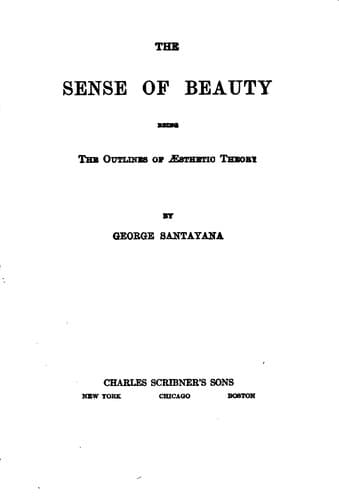
The Sense of Beauty: Being the Outlines of Aesthetic TheorySantayana, George
Philosophy
The Sense of Beauty: Being the Outlines of Aesthetic Theory
Santayana, George
Aesthetics
This is a beauty dependent on reverie, fancy, and objectified
emotion. The promiscuous natural landscape cannot be enjoyed in
any other way. It has no real unity, and therefore requires to have
some form or other supplied by the fancy; which can be the more
readily done, in that the possible forms are many, and the constant
changes in the object offer varying suggestions to the eye. In fact,
psychologically speaking, there is no such thing as a landscape;
what we call such is an infinity of different scraps and glimpses
given in succession. Even a painted landscape, although it tends to
select and emphasize some parts of the field, is composed by
adding together a multitude of views. When this painting is
observed in its turn, it is surveyed as a real landscape would be,
and apperceived partially and piecemeal; although, of course, it
offers much less wealth of material than its living original, and is
therefore vastly inferior.
Only the extreme of what is called impressionism tries to give
upon canvas one absolute momentary view; the result is that when
the beholder has himself actually been struck by that aspect, the
picture has an extraordinary force and emotional value -- like the
vivid power of recalling the past possessed by smells. But, on the
other hand, such a work is empty and trivial in the extreme; it is
the photograph of a detached impression, not followed, as it would
be in nature, by many variations of itself. An object so unusual is
often unrecognizable, if the vision thus unnaturally isolated has
never happened to come vividly into our own experience. The
opposite school -- what might be called _discursive_ landscape
painting -- collects so many glimpses and gives so fully the sum of
our positive observations of a particular scene, that its work is sure
to be perfectly intelligible and plain. If it seems unreal and
uninteresting, that is because it is formless, like the collective
object it represents, while it lacks that sensuous intensity and
movement which might have made the reality stimulating.
Public-domain text, read in full here on John Shaqi.
Reviews
Reviews
No reviews yet
Be the first to share your thoughts on this work.
Elsewhere in the archive
Join the Discussion
Join the discussion
Sign in to leave a comment or review.
Sign InorCreate an account