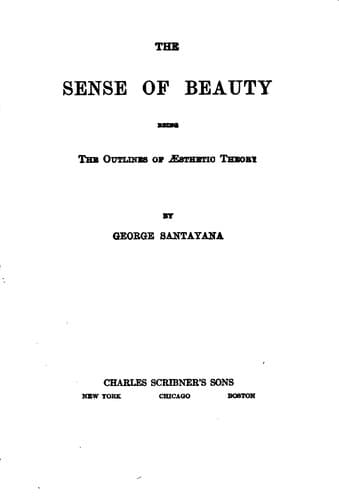
The Sense of Beauty: Being the Outlines of Aesthetic TheorySantayana, George
Philosophy
The Sense of Beauty: Being the Outlines of Aesthetic Theory
Santayana, George
Aesthetics
Sec. 35. The fondness of a race or epoch for any kind of effect is a
natural expression of temperament and circumstances, and cannot
be blamed or easily corrected. At the same time we may stop to
consider some of the disadvantages of a taste for the indeterminate.
We shall be registering a truth and at the same time, perhaps,
giving some encouragement to that rebellion which we may
inwardly feel against this too prevalent manner. The indeterminate
is by its nature ambiguous; it is therefore obscure and uncertain in
its effect, and if used, as in many arts it often is, to convey a
meaning, must fail to do so unequivocally. Where a meaning is not
to be conveyed, as in landscape, architecture, or music, the
illusiveness of the form is not so objectionable: although in all
these objects the tendency to observe forms and to demand them is
a sign of increasing appreciation. The ignorant fail to see the forms
of music, architecture, and landscape, and therefore are insensible
to relative rank and technical values in these spheres; they regard
the objects only as so many stimuli to emotion, as soothing or
enlivening influences. But the sensuous and associative values of
these things -- especially of music -- are so great, that even without
an appreciation of form considerable beauty may be found in them.
In literature, however, where the sensuous value of the words is
comparatively small, indeterminateness of form is fatal to beauty,
and, if extreme, even to expressiveness. For meaning is conveyed
by the _form_ and order of words, not by the words themselves,
and no precision of meaning can be reached without precision of
style. Therefore no respectable writer is voluntarily obscure in the
structure of his phrases -- that is an abuse reserved for the clowns
of literary fashion. But a book is a larger sentence, and if it is
formless it fails to mean anything, for the same reason that an
unformed collection of words means nothing. The chapters and
verses may have said something, as loose words may have a
known sense and a tone; but the book will have brought no
message.
In fact, the absence of form in composition has two stages: that in
which, as in the works of Emerson, significant fragments are
collected, and no system, no total thought, constructed out of them;
and secondly, that in which, as in the writings of the Symbolists of
our time, all the significance is kept back in the individual words,
or even in the syllables that compose them. This mosaic of
word-values has, indeed, a possibility of effect, for the absence of form
does not destroy materials, but, as we have observed, rather allows
the attention to remain fixed upon them; and for this reason
absence of sense is a means of accentuating beauty of sound and
verbal suggestion. But this example shows how the tendency to
neglect structure in literature is a tendency to surrender the use of
language as an instrument of thought The descent is easy from
ambiguity to meaninglessness.
Public-domain text, read in full here on John Shaqi.
Reviews
Reviews
No reviews yet
Be the first to share your thoughts on this work.
Elsewhere in the archive
Join the Discussion
Join the discussion
Sign in to leave a comment or review.
Sign InorCreate an account