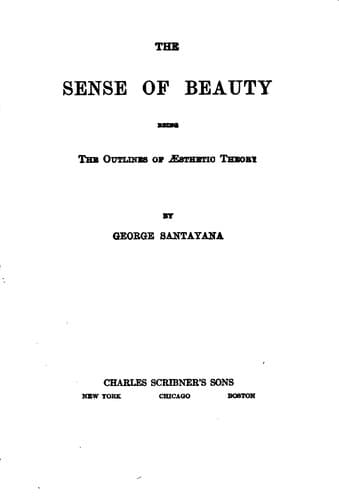
The Sense of Beauty: Being the Outlines of Aesthetic TheorySantayana, George
Philosophy
The Sense of Beauty: Being the Outlines of Aesthetic Theory
Santayana, George
Aesthetics
To say, however, that beauty is in some sense the ground of
practical fitness, need not seem to us wholly unmeaning. The fault
of the Platonists who say things of this sort is seldom that of
emptiness. They have an intuition; they have sometimes a strong
sense of the facts of consciousness. But they turn their discoveries
into so many revelations, and the veil of the infinite and absolute
soon covers their little light of specific truth. Sometimes, after
patient digging, the student comes upon the treasure of some
simple fact, some common experience, beneath all their mystery
and unction. And so it may be in this case. If we make allowances
for the tendency to express experience in allegory and myth, we
shall see that the idea of beauty and rationality presiding over
nature and guiding her, as it were, for their own greater glory, is a
projection and a writing large of a psychological principle.
The mind that perceives nature is the same that understands and
enjoys her; indeed, these three functions are really elements of one
process. There is therefore in the mere perceptibility of a thing a
certain prophecy of its beauty; if it were not on the road to beauty,
if it had no approach to fitness to our faculties of perception, the
object would remain eternally unperceived. The sense, therefore,
that the whole world is made to be food for the soul; that beauty is
not only its own, but all things' excuse for being; that universal
aspiration towards perfection is the key and secret of the world, --
that sense is the poetical reverberation of a psychological fact -- of
the fact that our mind is an organism tending to unity, to
unconsciousness of what is refractory to its action, and to
assimilation and sympathetic transformation of what is kept within
its sphere. The idea that nature could be governed by an aspiration
towards beauty is, therefore, to be rejected as a confusion, but at
the same time we must confess that this confusion is founded on a
consciousness of the subjective relation between the perceptibility,
rationality, and beauty of things.
_Utility the principle of organization in the arts._
Sec. 40. This subjective relation is, however, exceedingly loose. Most
things that are perceivable are not perceived so distinctly as to be
intelligible, nor so delightfully as to be beautiful. If our eye had
infinite penetration, or our imagination infinite elasticity, this
would not be the case; to see would then be to understand and to
enjoy. As it is, the degree of determination needed for perception is
much less than that needed for comprehension or ideality. Hence
there is room for hypothesis and for art. As hypothesis organizes
experiences imaginatively in ways in which observation has not
been able to do, so art organizes objects in ways to which nature,
perhaps, has never condescended.
Public-domain text, read in full here on John Shaqi.
Reviews
Reviews
No reviews yet
Be the first to share your thoughts on this work.
Elsewhere in the archive
Join the Discussion
Join the discussion
Sign in to leave a comment or review.
Sign InorCreate an account