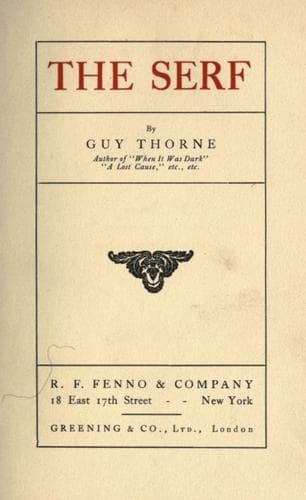
Great Britain -- History -- Stephen, 1135-1154 -- Fiction; Murder -- Fiction; Revenge -- Fiction; Serfs -- Fiction
They buried her with great pomp and few dry eyes, and Geoffroi paid for
many Masses, while Lerailleur bided his time. The rest we have heard.
Hyla and Lisolé sat gravely together on the deck of the boat. The relics
were put away in their shrine.
Neither said much for several hours, the thoughts of both were grave and
sad, and yet not wholly without comfort.
They seemed to see God's hand in all this. There was something fearful
and yet sweet in their hearts. So Sintram felt when he had ridden
through the weird valley and heard Rolf singing psalms.
The "midsummer hum"--in Norfolk they call the monotone of summer insect
life by that name--lulled and soothed them. There was peace in that deep
and secret hiding-place.
In the afternoon they broiled some firm white fish and made another
meal. "Come and see my field," said Lisolé afterwards.
They got into the small punt and followed a narrow way through the
reeds, going away from the wide stretch of water on the further shore
of which they had first met. At a shelving turfy shore they disembarked.
Climbing up a bank they came suddenly upon three acres of ripening corn,
a strange and pastoral sight in that wilderness. Small dykes covered
with bright water-flowers ran through the field dividing it into small
squares. It was thoroughly drained, and a rich crop.
"All my own work, Hyla," said the ex-jester, with no inconsiderable
pride in his voice. "I delved the ditches and got all the water out of
the land. Then I burnt dried reeds over it, and mixed the ashes with the
soil for a manure. Then I sowed my wheat, and it is bread, white bread,
all the year round for me. I flail and winnow, grind and bake, and no
man helps me. The monks would lend me a thrall to help, but I said no. I
am happier alone, La Guérisseur seems nearer then. I have other things
to show you, but not here. Let us go back to home first. To-day is a
holiday, and you also need rest."
When the moon rose and the big fishes were leaping out of the water with
resonant echoing splashes in the dusk, they were still sitting on the
deck of the boat in calm contemplation.
They spoke but little, revolving memories. Now and then the jester made
some remark reminiscent of old dead days, and Hyla capped it with
another.
About ten o'clock, or perhaps a little later, a long, low whistle came
over the water to them, in waves of tremulous sound. Lisolé jumped up
and loosened the painter of the punt. "It's one of the monks," he said;
"now and again they come to me at night time."
Hyla waited as the punt shot off into the alternation of silver light
and velvet shadow. Before long he heard voices coming near, and the
splash of the pole. It was a monk from Icomb, a ruddy, black-eyed,
thick-set man. His coracle was towed behind the punt.
He greeted the serf with a "benedicite," and told him that Lisolé had
given him the outlines of his story.
Public-domain text, read in full here on John Shaqi.
Reviews
Reviews
No reviews yet
Be the first to share your thoughts on this work.
Elsewhere in the archive
Join the Discussion
Join the discussion
Sign in to leave a comment or review.
Sign InorCreate an account