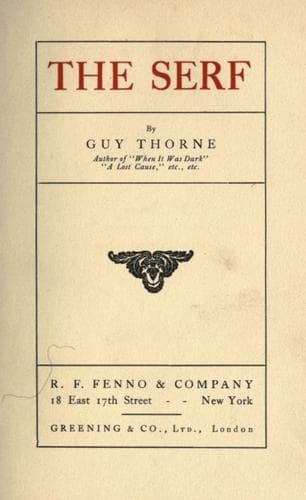
Great Britain -- History -- Stephen, 1135-1154 -- Fiction; Murder -- Fiction; Revenge -- Fiction; Serfs -- Fiction
"Say you so?" answered the jester. "Yet to be alone is a powerful good
thing. I have but hardly felt lack of humans this many a year. Many
sorry poor ghosts of friends, gone to death back-along, come to me at
night-time."
"And she, that saint that was thy wife, comes she to thee, Lisolé?"
"Betimes she comes, and ever with healing to my brain; but it is not the
wife who slept by my side."
"More Saint and less Woman! Is that truth?"
Lisolé nodded sadly. The big monk stretched himself out at length so
that the hot sun rays should fall on every part of him.
"I have no more to do with women," he said; "but in those other days I
liked a woman to be a very woman, and not too good. Else, look you,
wherein lieth the pleasure? It is because of the difference. Never
cared I for a silent woman. If you would make a pair of good shoon, take
the tongue of a woman for the sole thereof. It will not wear away. Full
many a worthless girl has enslaved me--me whom no enemy ever did. Yet
knowing all and seeing all, yet loved I all of them. And now--quantum
mutatus ab illo!"
He sighed, a reminiscent sigh. "They took from me all I had," he
continued, "and being poor and in distress I turned my thoughts
Godwards."
"Women, priests, and pullets have never enough," said Lisolé with a
sudden and quaint return of his professional manner. "They are past all
understanding, save only the saints. Truly I have found a woman to be
both apple and serpent in one. A woman, she is like to a fair table
spread with goodly meats that one sees with different eyes before and
after the feast."
"But hast feasted, brother, natheless? Forget not that."
"Art right, and it was well said. One should take bitter and sweet
together. Yet, friend, I do not doubt but that when the Lord Jesus fed
the concourse out of His charity and miracle, there were some at that
feast who told one another the bread was stale and the fish too long out
o' water! Men are so made. It is so in this life."
"Aye, and thou doest well in leaving this world for the Church's peace.
Now thy enemy is dead and thy hate with him thou shalt find peace, even
as I have done. For in what a pass is England! Peace being altogether
overthrown love is cooled; all the land is moist with weeping, and all
friendship and quietness is disappeared. All seek consolation and quiet.
Almost all the nobles spend their time in contriving evil; the mad
esquires delight in malice. These cruel butchers despise doctrine, and
the holy preachers have no effect. These men will not be amended by
force of sermons, nor do they take any account of the lives of men. They
all plunder together like robbers."
His voice rose in indignation, and both Hyla and the jester raised their
heads in bitter acquiescence.
It was so true of that dark time. Each one there was a waif of life, a
somewhat piteous jetsam from the dark tides which had almost
overwhelmed them. The Anglo-Norman song was very true--
"_Boidie ad seignurie, pes est mise suz pé._"
Public-domain text, read in full here on John Shaqi.
Reviews
Reviews
No reviews yet
Be the first to share your thoughts on this work.
Elsewhere in the archive
Join the Discussion
Join the discussion
Sign in to leave a comment or review.
Sign InorCreate an account