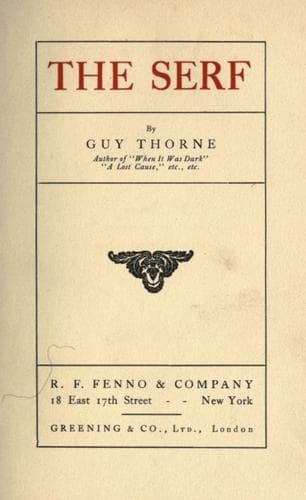
Great Britain -- History -- Stephen, 1135-1154 -- Fiction; Murder -- Fiction; Revenge -- Fiction; Serfs -- Fiction
It was about eleven o'clock in the morning, and he was pretending to
take an intelligent interest in the activity all round. He regarded four
great bundles of newly made arrows tied up with rope in the manner of a
connoisseur. He even took one out from its bundle, felt the point, and
held it on a level with his eye to make sure that the shaft was
perfectly straight and true.
Then he went to a heap of raw hides and felt their texture. This done he
stood before a mangonel, which was being hoisted up upon the walls by a
windlass, and surveyed it with an affectation of the engineer and a
flavour of the expert at home. But he did it very badly, and the whole
proceeding was an obvious effort. After that, feeling that he had done
his duty, he went to the draw-well in the centre of the courtyard, and,
sitting on the ground on the shady side--for it was a structure of
masonry some four feet high, like all Norman walls--composed himself to
sleep. The creature felt out of place. Upon first news of the coming
attack he was hard at work shriving blackguards, and allowing each one
to believe that should an arrow of the enemy put a swift end to his
sinful life, the saints and angels would meet them at the jasper gates
of heaven with trumpets and acclamations. The fools believed him; it
flattered them to hear of these fine things provided for an unpleasant
contingency, and no one was more important than Sir Anselm. Then came
the ceremonial importance of the funeral and the votive Mass. That kept
him well in the public eye for a little time. But this and that done, he
found time hang very heavy upon his hands.
All round him activity was being pushed to its furthest limit, and in
all that hive he was the only drone. The squires passed him with a jest,
the waiting maids threw a quip at him. Lewin alone was friendly, but the
minter had but little time to spare. That quick brain and alert eye for
the main chances in life were very valuable at Hilgay, and Lewin was in
constant request. The man suggested, advised, and directed operations
which were the wonder of all who saw them.
But he said nothing of the crack in the orchard wall.
The precious couple were quite resolved upon the treachery which they
had plotted in the fen. In truth Fulke was a bestial young fool, and
offered no inducement to his followers to be faithful. Roger Bigot was a
bigger man in the world, and reputed to be very fair with all his
people. Lewin certainly would gain by the change. As for Dom Anselm, he
knew perfectly that Roger would never need a priest, for--a strange fact
even in those dreadful days--he was an open scoffer. At the same time,
the scoundrel was rather tired of the business. Among men-at-arms it was
not lucrative, though their superstition enjoined a certain amount of
respect for him. He knew a little about the rude medicine of that time,
had some skill in simples, and he would, he thought, join Roger as a
chirurgeon provided that all went well.
Public-domain text, read in full here on John Shaqi.
Reviews
Reviews
No reviews yet
Be the first to share your thoughts on this work.
Elsewhere in the archive
Join the Discussion
Join the discussion
Sign in to leave a comment or review.
Sign InorCreate an account