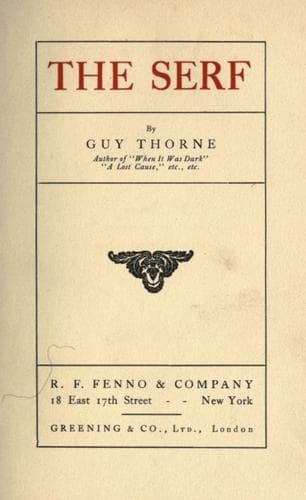
Great Britain -- History -- Stephen, 1135-1154 -- Fiction; Murder -- Fiction; Revenge -- Fiction; Serfs -- Fiction
When the Baron reached his room he proceeded to discuss the method of
Hyla's execution with his friends.
He wanted, he said, to make a very public thing of it, indeed he was
quite determined to hang him from the very top of Outfangthef. At the
same time that was far too easy a death.
They turned their four evil brains to the question of torture, a grim
conclave, and, curiously enough, it was the keenest and most refined
intelligence which invented the worst atrocities. Lewin proposed things
more horrible than Fulke could ever have thought of. They applauded him
for his very serviceable knowledge of anatomy. The pain of Hyla, it was
eventually settled, was to last till he could bear no more, and he
should hang from the Tower at the end. With that decision made they fell
drinking, for Hyla was not to suffer until after the mid-day meal.
The two men chosen to inflict the torture were two swarthy foreign
scoundrels from Mirebeau, men who knew no earthly scruple. About two in
the afternoon a little procession started to the guard-house.
Lewin's interest in the proceedings was already over. He did not join
them. He had suggested various tortures, it was a mental exercise which
amused him, but that was all. Nothing would have induced him to watch
his own horrible brutalities being inflicted on the victim.
He threaded his way among the pens of lowing cattle and the litter of
war material to a tower in the forework, and presently, as the long
afternoon waned lazily away, his quick eyes caught sight of a clump of
spears, a mile away, on the edge of the wood.
By half the night was over, Hilgay was invested. All round the walls
camp-fires glowed in the dark, and snatches of song in chorus could be
heard, or a trumpet blaring orders. Now and again the guards upon the
battlements would hear the thunder of a horse's hoofs, as some officer
or galloper went _ventre à terre_ down the village street, and a few
random arrows went singing after him.
Every one anxiously awaited the day.
CHAPTER XVII
"So when this corruptible shall have put on in corruption, and
this mortal shall have put on immortality; then shall be brought
to pass the saying that is written, Death is swallowed up in
victory. O death, where is thy sting? O grave, where is thy
victory?"
Huber, the man-at-arms, went slowly round the battlements as the sun
rose. He was in full panoply of war time. A steel cap was on his head,
and he wore a supple coat of leathern thongs laced together, and made
stronger by thin plates of steel at the shoulder and upper part of the
arms.
He had a long shield on his left arm, a cavalry shield notched at the
top for a lance. He was inspecting the defences, and he carried this
great shield to protect himself from any chance shaft from the enemy,
for he made a conspicuous mark every now and again against the sky line.
Public-domain text, read in full here on John Shaqi.
Reviews
Reviews
No reviews yet
Be the first to share your thoughts on this work.
Elsewhere in the archive
Join the Discussion
Join the discussion
Sign in to leave a comment or review.
Sign InorCreate an account