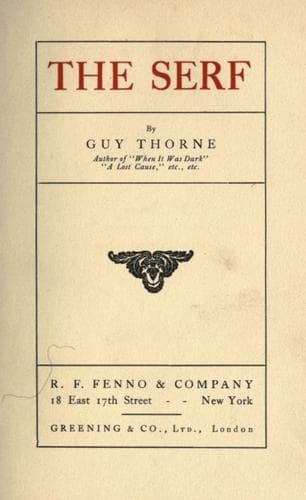
Great Britain -- History -- Stephen, 1135-1154 -- Fiction; Murder -- Fiction; Revenge -- Fiction; Serfs -- Fiction
The squire made a funnel of his hands and gazed at the flag. "A moline
cross, if I see aright," he said, "but it does not matter. Roger's flag
eke his coat-armour, are what he has a mind to use, not what he useth by
any right of birth."
"Can'st see what they are doing out by the carts--by the edge of the
orchard?"
"Yes, sir. They be working on the mantelets, and anon they will wheel
them up to protect those who would raise a palisade on the moat's edge.
But come, Master Richard, we must be on the rounds. Much must be looked
to. Now look you, Sir Brian, in a siege the hoards are your defender's
chief stand-by. Now we are going into each one, for it is in those
defences that we must trust in time of attack. When your hoards are
breached, then your castle is like to fall."
He spoke with the technical assurance of a veteran--a sergeant-major
respectfully imparting his own riper knowledge to a brace of subalterns.
The "hoards" were wooden structures, little pent-house forts, run out
from the curtains, standing on great beams which fitted into holes in
the masonry. From behind the breastwork of thick wood the archers could
shoot with a freedom--this way and that--which was denied them by the
long oblique openings in the wall itself. They commanded all points.
The group walked out along the narrow gangway, which stretched out over
the black moat below, and entered the temporary fort of wood. It was
built for the accommodation of four or five men, sharpshooters, who were
practically safe from everything but heavy artillery fire from mangonel
and catapult.
They surveyed the scene before them in silence. The morning had risen
clear, calm, and hot. For weeks the morning had been just as this was,
and they had strolled along the battlements to catch the cool air and
sharpen an early appetite. But on those other days the meadows beyond
the moat, which ran to the forest edge, had been silent and empty, save
for herds of swine and red peaceful cattle. Now, but two hundred yards
away, scarce more than that it seemed in the clear keen air of dawn,
were the tents, the dying fires, the litter and stir, of a great hostile
camp.
The lines of men, horses, and carts, stretched away right and left in a
long curve, till Outfangthef hid them on one side, and the gateway
towers, with their pointed roofs, upon the other.
They could hear the trumpets, the hammers of the carpenters, a confused
shouting of orders, and the hum of active men, as the besiegers began to
prepare the manifold engines of attack, which--perhaps before night
fell--would be creeping slowly towards the walls of Hilgay.
That great low shed which lay upon the ground like a monstrous tortoise,
would presently creep slowly towards them, foot by foot, until it
reached the edge of the moat, and the men beneath it would build their
great fence of logs and empty carts of rubbish into the sullen waters.
Public-domain text, read in full here on John Shaqi.
Reviews
Reviews
No reviews yet
Be the first to share your thoughts on this work.
Elsewhere in the archive
Join the Discussion
Join the discussion
Sign in to leave a comment or review.
Sign InorCreate an account