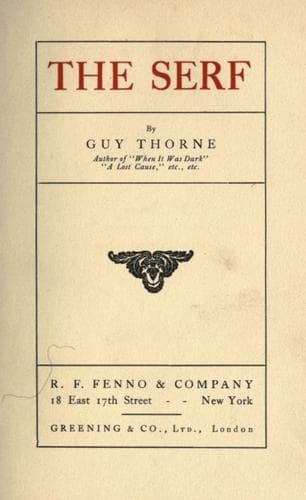
Great Britain -- History -- Stephen, 1135-1154 -- Fiction; Murder -- Fiction; Revenge -- Fiction; Serfs -- Fiction
Their lives were framed in stone, and swords were about them. They were
very ignorant, very prejudiced, superstitious and dirty--a big
indictment! Nevertheless, it is certain that their influence upon the
time was good and pure. It is the fashion to rail at monasteries of all
periods. Many blockheads can never get over the mere _fact_ of the
Dissolution! In a spirit of curiosity I examined half-a-dozen histories
of the baser type--the sort of histories that are still given to
fourth-form boys and quite grown-up girls. One and all, if they
mentioned the monasteries in the reign of King Stephen at any length,
either openly condemned them or damned them with faint praise. I take
this opportunity of correcting messires, the historians, upon a point of
FACT. It is odd that the hopelessly incompetent clergyman-schoolmaster
should so invariably turn historian to-day. His monumental and appalling
ignorance of the times and peoples he treats of--ignorance unillumined
with a single ray of insight--is displayed on every line of his
lucubrations. Nothing, apparently, would lead him to read and dig and
sift for himself so that he might know just a little of what he writes
about. Let me, at any rate, assure him, that while, as is natural, there
were plenty of bad monks in the reign of Stephen, as a whole, the
monasteries were very praiseworthy institutions, and had a beneficent
influence upon the country. In short, my little priory at Icomb, is a
perfectly fair and typical example of its class.
While the monks were in the chapter-house, and afterwards attending a
special service in the chapel, a long boat glided rapidly over the lake.
It was a dark, thunderous night, and nothing betrayed the quiet passage
of the craft, save the dusky glitter of the water as the oars rose and
sank. Now and again some low orders in Norman-French regulated the pace
or altered the direction of the boat.
When the voyagers were about half-way across the mere, as near as they
could judge, they heard the sudden tolling of the great bell of the
Priory. The sullen, angry notes came across the water, out of the dark,
in waves of booming sound. There was a muttered order, and the oars
stopped in their swing. The boat rushed on for thirty yards or so,
gradually losing its momentum, until at length it became stationary.
"What does that betoken, Huber?" asked a voice.
"I do not know," replied the man-at-arms. "Pardieu, I cannot tell."
"Do you think they know that we are near?"
"Not unless they have found out that Heraud has come with a certain
purpose. Perchance Hyla saw him and recognised him."
"Not he. Heraud shaved his face and cropped his hair, and the minter
drew lines upon his face, and painted the poor divell's visage all over
with some hell brew. I seed them at it. His own mother would never have
thought him made of her blood."
"Then, by Godis teeth! what does the bell mean?"
"Oh, the old women are making prayers or saying Mass."
Public-domain text, read in full here on John Shaqi.
Reviews
Reviews
No reviews yet
Be the first to share your thoughts on this work.
Elsewhere in the archive
Join the Discussion
Join the discussion
Sign in to leave a comment or review.
Sign InorCreate an account