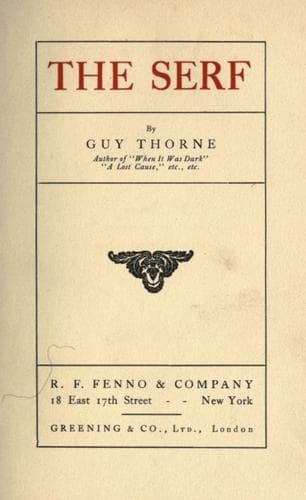
Great Britain -- History -- Stephen, 1135-1154 -- Fiction; Murder -- Fiction; Revenge -- Fiction; Serfs -- Fiction
"Depardieux! and well you might. I did not think of that. But natheless,
that bell means good fortune for our little plan, my friends. All the
monks and all the villeins from the village have gone inside to service
in the chapel. Only the theows are alone, and it will be an easy matter
to take the man without interference if we are quick."
"How far is it from here?"
"As a bird flies, about two furlongs. But it will be longer for us, for
we must make a detour to keep away from the walls. We shall come on the
village from behind. There is a big midden ditch, but I have a plank to
cross it."
"We'll give Sir Hyla a dip in it as we pass."
"'Twould be a fitting mitra."
Then with no more words, led by Heraud, they left the boat and stole
silently up the hill in the dark.
An archer remained in the boat to guard it and to help them to find it
again.
Hyla retired into his hut about half-past eight. He had been working all
day, cleaning out pig-styes and carting the manure to the ditch which
ran north of the village, and which served as a slight defence, and also
as a storing place for fertilizing material to spread upon the fields. A
strange occupation, perhaps, for a man who had but lately done a deed
of such moment, and who was more than half a hero! But he had been set
to this work purposely by the monks, who knew human nature, and thought
it best for the man. The monks were the only psychologists in the
twelfth century.
With some men this would have been wise, no doubt, but to Hyla's credit
it should be said that he thought very little about himself. His rather
heavy, sullen manner may easily have conveyed a false impression as to
his own estimate of himself, but he was humble enough in reality.
In fact, Hyla was too humble, and more so than befitted his strong
nature. He cleaned the filth from the styes with never a thought that he
might be better or more profitably employed. And in this fact we have
another vivid expression of the psychology of serfdom.
The only certain way in which it is possible to get at the inner meaning
of a period in history, is by the comparison of the attitude of an
individual brain towards his time, and the attitude of a general type of
brain. The individual with the point of view must, of course, be a known
quantity.
Historians, I am certain, have not yet entirely realised this simple and
beautiful method. Properly understood, it is as mathematically exact as
any comparative method can possibly be. It is the way in which history
will be written in the future when the modern Headmaster-Historian will
no longer be allowed to write an "epoch" and dispose of the two first
editions entirely among the boys of his own school.
Of its extreme fascination as a pursuit the cultured cannot speak too
highly. It combines the pleasures of the laboratory with the pleasures
of psychology, and never was Science so happily wedded to Art.
Public-domain text, read in full here on John Shaqi.
Reviews
Reviews
No reviews yet
Be the first to share your thoughts on this work.
Elsewhere in the archive
Join the Discussion
Join the discussion
Sign in to leave a comment or review.
Sign InorCreate an account