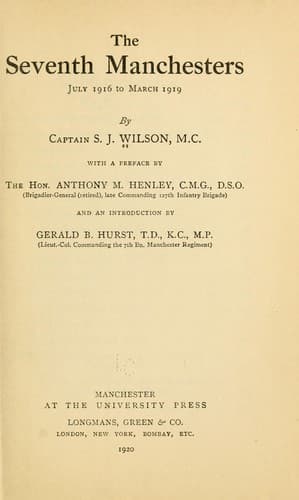
The Seventh Manchesters: July 1916 to March 1919Wilson, S. J.
History
The Seventh Manchesters: July 1916 to March 1919
Wilson, S. J.
Great Britain. Army. Manchester Regiment. Battalion, 7th (Territorial); World War, 1914-1918 -- Regimental histories -- Great Britain
The fortnight at Warlencourt was spent in refitting, and intensive
training in attack. One day was occupied by a demonstration of an
assault by a company, using live ammunition. This was carried out by "D"
company in the presence of the corps commander and large numbers of
officers and N.C.O's. of the division, and was followed by educational
criticism by the General.
THE HINDENBURG LINE.
It was obvious that all this had a specific purpose, and we were not
left long to wonder what the purpose was. A tremendous battle was
brewing, and rumours placed its magnitude at from three army fronts to
the whole allied front. Anyhow, the chief thing that concerned us was
that the 42nd was to take part in the cracking of the hardest nut in the
German defence, namely, the Hindenburg system. The enemy had had three
weeks in which to consolidate his already perfected ramification of
trenches and dug-outs, and there was no doubt as to their determination
to definitely stop the British advance there. If this failed they had
lost the War.
On September 22nd the division marched up, and took over the front from
the 37th division, the 125th brigade occupying the forward positions
just east of Havrincourt Wood. The 7th found themselves out in reserve
just north of the Canal du Nord behind Hermies, and it was pleasing to
see the old haunts again. Men thought grimly of the experiences we had
been through since those happy days more than a year ago, and these
sights served to call up the memory of many a pal who had since made the
big sacrifice. And now, perhaps, we should get an opportunity of seeing
those mysterious lands beyond Flesquieres, Marcoing and so on, that we
had gazed upon so long. As far as possible training was continued and a
certain amount of company re-organisation took place. Owing to the
weakness of companies they had been reduced to three platoons, some of
these being much below strength. Reinforcements had been expected, but
they did not materialise to an appreciable extent. However, the
exigencies of the task in hand demanded that the four platoon formation
should be adopted in spite of the small numbers. In view of this,
therefore, it was necessary to crowd in rapid training in attack on this
principle, so that each man should be well acquainted with his function.
After the battle surplus had been eliminated the company commanders were
as follows:--"A" company, Capt. Nelson, "B" Lt. S. J. Wilson, "C" Capt.
Allen, M.C., and "D" Lieut. Gresty, M.C. Lt.-Col. Manger commanded the
battalion, while Capt. Creagh had returned and was Adjutant. Two days
before the attack Capt. Nelson went into hospital with dysentery which
had frequently recurred in a violent form during the preceding weeks. A
slight re-adjustment was thus demanded amongst the officers to give
every company a fair share of leadership and Lieut. Hammond was sent to
command "A" company.
Public-domain text, read in full here on John Shaqi.
Reviews
Reviews
No reviews yet
Be the first to share your thoughts on this work.
Elsewhere in the archive
Join the Discussion
Join the discussion
Sign in to leave a comment or review.
Sign InorCreate an account