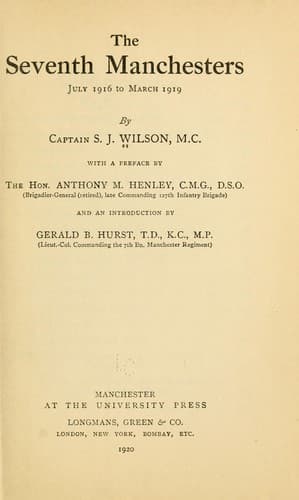
The Seventh Manchesters: July 1916 to March 1919Wilson, S. J.
History
The Seventh Manchesters: July 1916 to March 1919
Wilson, S. J.
Great Britain. Army. Manchester Regiment. Battalion, 7th (Territorial); World War, 1914-1918 -- Regimental histories -- Great Britain
On the morning of Sept. 26th final operation orders were issued, and
that night we moved up to our assembly positions in a huge dug-out near
Femy Wood, capable of holding the whole battalion. It was slow work
moving along the canal and across the Trescault-Havrincourt road, and it
is not surprising that eventually the intervals between platoons closed
up and the four companies were strung out in one long line. The
confidence felt in the success of the operations, was evident by the
fact that the 6-inch howitzers were installed in front of the Trescault
road within 500 yards of the enemy. Whilst we were assembling there
were motor lorries on the road unloading stacks of ammunition for them!
By the time the battalion had been packed into the dug-out dawn was
swiftly approaching, which meant the commencement of the battle, for
Zero for the third army was 5.25 a.m. The VIth corps, the 62nd division
of which touched up with our left, were to have three hours' fighting
before we commenced, and for this reason we welcomed the shelter of the
dug-out while it was in progress. The configuration of the ground was
responsible for the manner in which the battle was to grow along the
whole front. The advance of the 127th brigade was to take place along
the shoulder of a long hill running broadly east to west. North of this
high ground was a long valley stretching through Ribecourt towards
Marcoing. Another shoulder similar to but higher than ours flanked the
valley on the north, and it was this, together with the commanding
village of Flesquieres, that the VIth corps were to make good before our
attack commenced. Again, the 125th brigade, who were on our right, and
also on the higher part of the shoulder, were to open the 42nd
divisional assault half an hour ahead of ourselves.
About 8 o'clock "C" company led the way out of the dug-out and took up
their assault positions near the front line. At the appointed hour,
following behind the 5th, they moved forward to the attack, in the
formation which we had practised so frequently, and which was the most
suitable for the large frontage that had to be covered. All four
platoons were in line, and each platoon was divided into four sections,
the two rifle sections on the flanks, and the two L.G. sections in the
middle and echeloned to the rear. This was the artillery formation
useful for covering the ground previous to the actual assault, each
section moving in file (_i.e._, two ranks) well opened out. When close
to the enemy position the platoons extended and formed two lines, with a
L.G. in the centre of each line, and riflemen on the flanks. Every
Company went over in this formation, and strict orders were issued that
no man was to enter the enemy trenches for the purpose of covering the
ground, but to keep out in the open, otherwise great confusion would
arise, and officers would lose control of their men.
Public-domain text, read in full here on John Shaqi.
Reviews
Reviews
No reviews yet
Be the first to share your thoughts on this work.
Elsewhere in the archive
Join the Discussion
Join the discussion
Sign in to leave a comment or review.
Sign InorCreate an account