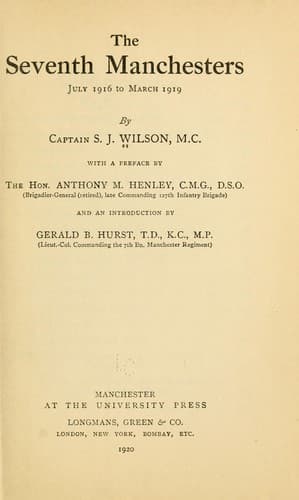
The Seventh Manchesters: July 1916 to March 1919Wilson, S. J.
History
The Seventh Manchesters: July 1916 to March 1919
Wilson, S. J.
Great Britain. Army. Manchester Regiment. Battalion, 7th (Territorial); World War, 1914-1918 -- Regimental histories -- Great Britain
This town is a sister in misfortune to Ypres, but the destruction was
even more complete because it was almost in the front line, and shells
of all calibres dropped in it well-nigh continuously day and night.
Peace-time bridges, of course, had been obliterated, but soldiers had
built others to connect up the front line defence, which was east of the
river, with the rear. Who will ever forget Putney Bridge? Lancashire men
who knew nothing of its parent in London, had now perforce to take a
lively personal interest in this wobbly structure. There were two others
but they were not so famous as this because they were not so frequently
used. Many things can be camouflaged to deceive aircraft, but I think a
bridge over a river would tax the most ingenious in this art, hence,
although hidden from direct observation from the enemy lines, the Hun
had the exact position of these bridges, and, what was more
disconcerting, he also had the exact range. So he "dusted" them at
irregular intervals with various calibres, and trips across resembled
the noble game of running the gauntlet. This portion of night reliefs
was naturally particularly exciting. The late Lt.-Col. Marshall, V.C.,
when second in command to the 6th L.F's., provided an amusing story for
the division one day when a couple of officers failed to salute him in
the middle of Putney Bridge, he walking calmly across, and
they--obviously hurrying. He pulled them up and strafed them duly, then,
to force his point, he stood on the bridge and caused them to pass him
two or three times in a dignified manner and salute him correctly.
Luckily the Boche did not interfere in this little humorous interlude.
The Redan was a large triangular redoubt, with the base resting on the
river and having an artificial moat through the middle and on its other
two sides. It had been built many years ago to defend Nieuport and in
this war had played its part. The enemy had paid a good deal of
attention to it with heavy shells so it was considerably knocked about.
Most of the concreted dug-outs, however, were still intact, and they
served to house a good portion of the 7th in their support position.
Headquarters inhabited the ever famous Indiarubber House. This resembled
an innocent barn in appearance, and the Hun had hit it hard many many
times, but his shells had only bounced harmlessly off the solid
concealed concrete--hence its name. The French, in the quiet days, had
"done themselves well" here, and we thanked them for the excellent
supply of electric light which they had handed over.
Public-domain text, read in full here on John Shaqi.
Reviews
Reviews
No reviews yet
Be the first to share your thoughts on this work.
Elsewhere in the archive
Join the Discussion
Join the discussion
Sign in to leave a comment or review.
Sign InorCreate an account