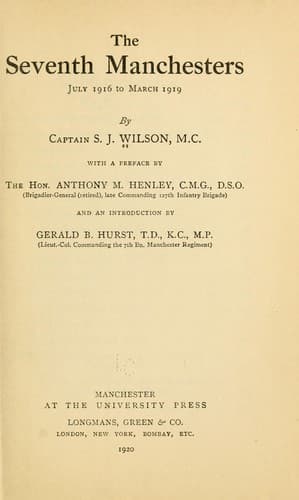
The Seventh Manchesters: July 1916 to March 1919Wilson, S. J.
History
The Seventh Manchesters: July 1916 to March 1919
Wilson, S. J.
Great Britain. Army. Manchester Regiment. Battalion, 7th (Territorial); World War, 1914-1918 -- Regimental histories -- Great Britain
It was when we took over the front line, however, that the real meaning
of the Nieuport sector was revealed. The ground was torn and devastated
like the Salient, but here the destruction and misery was increased by
floods, ever present in a greater or less degree. It had been impossible
to dig in the low ground, so the defences consisted of breastworks which
had been very much battered since the enemy had established his
superiority here in guns. Over this area the Boche had uninterrupted
observation from the ruins of Lombaertzyde, which lay on slightly higher
ground just within his lines. It was thus practically impossible to move
about by day, for the sight of khaki brought down a hurricane of whizz
bangs, special batteries being apparently told off for sniping of this
nature. Further, as we lay in a very sharp salient just here our men
could be plainly seen behind the breastworks by the enemy on their right
rear, and these people indulged in long range machine gun sniping.
Since our purpose was a "peaceful" one in this sector, we could see no
value in inviting the enemy to indulge in artillery and M.G. target
practice on us, so we lay "doggo" during the day. Everything had to be
done at night, and runners to the companies found this their busiest
time, wading thigh-deep through stretches of water, and picking their
way amongst innumerable shell holes in search of Company Headquarters.
This front also lent itself to heavy trench-mortar work by the Hun, and
"minnies" were constantly stealing over with evil intent to batter down
our flimsy breastworks. Battalion H.Q. and the signallers will probably
not easily forget the morning when they found themselves the objective
in this kind of work. One shot dropped plumb on the H.Q. concrete
shelter, half removing the roof and scattering the contents of the
orderly room in a disrespectful manner, whilst the next one pushed in
the signaller's dug-out, wounding L.-Cpl. Wild. It was the sang-froid of
a/R.S.M. Clough on this occasion, coupled with his sound work generally
in the line, which earned for him the Belgian Croix de Guerre.
Public-domain text, read in full here on John Shaqi.
Reviews
Reviews
No reviews yet
Be the first to share your thoughts on this work.
Elsewhere in the archive
Join the Discussion
Join the discussion
Sign in to leave a comment or review.
Sign InorCreate an account