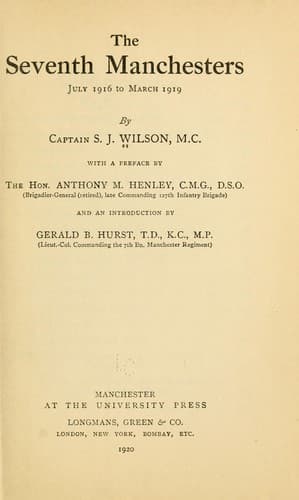
The Seventh Manchesters: July 1916 to March 1919Wilson, S. J.
History
The Seventh Manchesters: July 1916 to March 1919
Wilson, S. J.
Great Britain. Army. Manchester Regiment. Battalion, 7th (Territorial); World War, 1914-1918 -- Regimental histories -- Great Britain
We had the 2nd Matrosen (Naval) division in front of us, and they were
really an enterprising lot. Undoubtedly our pressure upon Paschendaele
was making the German nervy on this sector, and he was under an
obligation to keep alive and display a vigorous activity. Further, his
morale was considerably heightened by the Teutonic success in Italy
which his wireless sets were busy blazoning forth to all the world. This
will account, therefore, for the sudden arrival of an enemy patrol
outside one of our isolated posts one night. They flung in bombs over
the scanty wire, inflicting casualties, and then rapidly departed. This
was a sting which had to be avenged, and while the 5th were in they
took first toll by meeting a Hun patrol in No Man's Land, and after
fighting it out returned triumphant with two prisoners, who proved to be
Bavarians, thus giving a valuable identification. When we took over, our
chance came very soon for a patrol was met on the same game as before.
The result was discomfiture of the enemy and the capture of a wounded
petty officer of the Matrosens. From these two events we could
approximately deduce the enemy divisional boundary. The next night,
determined to assert our superiority over the Boche, another of our
patrols from "A" company, journeyed forth, got through his wire, located
a post, and then filled it with bombs.
After seventeen days of amphibious soldiering in front of Nieuport we
were relieved by the 125th brigade, and went back for a welcome rest to
huts near Coxyde. Rumours drifted around about accompanying the 41st
division to Italy, but they did not materialise. Bitterly cold weather
suddenly arrived, however, which made us aware of the flimsiness of the
French huts in which we dwelt.
CHAPTER VI.
An Interlude.
The 42nd division added to its list of new experiences when it was
relieved at Nieuport, by a division of French troops. We afterwards
heard that they had demonstrated their capacity for common sense in
warfare by evacuating all the horrible ground in front of the Redan,
which we had clung to with characteristic British bull-dog tenacity.
Lt.-Col. Carr, D.S.O., having proceeded on leave, Major Allan commanded
the battalion during the succeeding days. It was found later, however,
that the C.O. would not return, having been placed on the sick list at
home. The division was destined for Bethune and it was a very pleasant
five days' march that took us to that area. On the first day, Nov. 16th,
passing through Leffinckoucke, near Dunkirk, we reached Teteghem, while
the next day took us to Esquelbec, just outside Wormhoudt. The following
two days required only short distances to the Hazebrouck district, but
the fifth day was longer, and, marching past the divisional commander in
Aire, we arrived at Mazinghem, a small village just off the main Lillers
road.
Public-domain text, read in full here on John Shaqi.
Reviews
Reviews
No reviews yet
Be the first to share your thoughts on this work.
Elsewhere in the archive
Join the Discussion
Join the discussion
Sign in to leave a comment or review.
Sign InorCreate an account