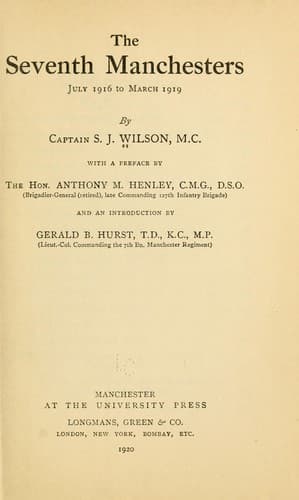
The Seventh Manchesters: July 1916 to March 1919Wilson, S. J.
History
The Seventh Manchesters: July 1916 to March 1919
Wilson, S. J.
Great Britain. Army. Manchester Regiment. Battalion, 7th (Territorial); World War, 1914-1918 -- Regimental histories -- Great Britain
The battalion spent a few days here, and a really happy time it was. The
villagers had not become blase to British soldiers, and they gave our
men a hearty welcome in their billets. It was with no small pride that
the cure, with whom the padre and myself were lucky enough to be
billeted, informed us that General Petain had at one time spent many
happy days in his house, for his uncle had been the cure here. Whilst in
this village we received the news of the wonderful Cambrai attack by
General Byng, and we had a curious feeling that he had no right to do
that without asking the 42nd to help him, for we naturally possessed a
fatherly interest in Havrincourt and all its works. The first flush of
news gave us no details, and we were perplexed to know what had happened
to "Jerry's Wire" which we knew was formidable enough. Then the stories
of tanks upon tanks drifted through, and we began to understand it.
It was here that Lt.-Col. Bromfield, of the Leicestershire Regt. first
saw the 7th and assumed command. He was due for leave, however, and had
just emerged from a trying time at Paschendaele, so Major Allan was soon
left in charge once more. We did not remain long at Mazinghem for our
duty was to relieve the 25th division in the line at Givenchy, before La
Bassee. As everyone knows, this was one of the sectors of the original
British line so that everything connected with it was essentially
English. Since the fighting at Festubert in 1915 comparative peace had
reigned along this front and we were content to allow it to remain so
after our noisy experiences at Ypres and Nieuport.
Givenchy was once a mining village situated on a spur of the Aubers
Ridge, which, running west to east, looks down upon the flat ground,
stretching uninterruptedly northwards through Festubert, Neuve Chapelle
and Laventie towards Armentieres. Someone had facetiously suggested in
the trench diary (a beautifully bound document that had been handed down
from battalion to battalion from early days) that "Givenchy Church be
kept in a state of repair for the Huns to register on," and therein lies
an important fact. Had the church tower been standing, and one could
have got into it, a glorious view of a large part of Northern France
would have been obtained. Looking eastwards one saw La Bassee half
concealed by thick woods while to the northeast were the outskirts of
Lille. Southwards and south-west were the mining villages of the Lens
district with their huge conical fosses. In other words, Givenchy was an
important tactical point and the fiercest efforts of the Boche in 1914
had failed to move British troops from it, although at the end of the
fighting it lay in a very sharp salient, which was only straightened out
after Festubert in 1915.
Public-domain text, read in full here on John Shaqi.
Reviews
Reviews
No reviews yet
Be the first to share your thoughts on this work.
Elsewhere in the archive
Join the Discussion
Join the discussion
Sign in to leave a comment or review.
Sign InorCreate an account