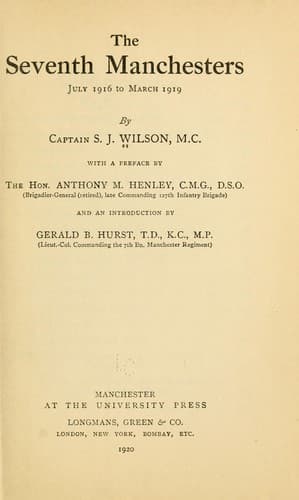
The Seventh Manchesters: July 1916 to March 1919Wilson, S. J.
History
The Seventh Manchesters: July 1916 to March 1919
Wilson, S. J.
Great Britain. Army. Manchester Regiment. Battalion, 7th (Territorial); World War, 1914-1918 -- Regimental histories -- Great Britain
As daylight approached on the 25th it was obvious, from the increasing
proximity of rifle fire on our left, that Mory had fallen and the line
was falling back steadily. Quiet seemed to reign now, however, in the
direction of Behagnies. We later discovered that the L.F's. had received
orders to push on and cover the Behagnies-Sapignies Road, and this they
had successfully achieved in the night. At the same time the 126th
brigade was in touch with the enemy in front of Ervillers, so that on
the morning of the 25th all three brigades were in the front line and
were rigging up an impromptu battle with the Hun. The enemy soon made
his intentions clear and he commenced a vigorous assault. What troops
still remained of the 40th and other divisions, when they found that the
42nd were in position, gradually dribbled through in search of a
long-delayed and well-earned rest. They had been fighting without
respite since the morning of the 21st. The 6th Manchesters were now on
the right of the division in the vicinity of Bihucourt, but they were
uncertain as to the state of affairs on their right. As a matter of
fact, although we were not aware of it at the time, Bapaume had been
taken and a large gap had been left in the line south of our right
flank, through which the Huns were pouring in victorious mass. The New
Zealand division and one brigade of Australians, with the 62nd division
on their left were hurried forward, and after very severe fighting
stopped the enemy rush about Hebuterne, some miles westward of the
position we held on March 25th.
Meanwhile we were in blissful ignorance of our hazardous position and
the Manchesters were preserving strict guard over an exposed right
flank. The 6th came in for a good deal of heavy fighting in the vicinity
of Bihucourt, but they held the village all day. The headquarters of the
7th was in an old shallow dug-out close to the light railway that had
been constructed from Achiet-le-Grand to run eastwards in the direction
of Bullecourt. This railway wound its way through a sort of valley to
the north of which lies Gomiecourt and to the north-east Mory. Due east
on higher ground are Behagnies and Sapignies where the L.F's. were
making such a fine stand. This high ground continues southwards towards
Bihucourt and Bapaume, and it was along this ridge that most of the
day's fighting took place.
Public-domain text, read in full here on John Shaqi.
Reviews
Reviews
No reviews yet
Be the first to share your thoughts on this work.
Elsewhere in the archive
Join the Discussion
Join the discussion
Sign in to leave a comment or review.
Sign InorCreate an account