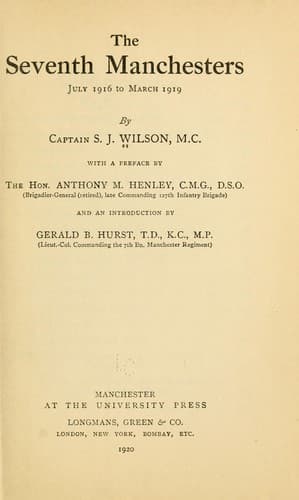
The Seventh Manchesters: July 1916 to March 1919Wilson, S. J.
History
The Seventh Manchesters: July 1916 to March 1919
Wilson, S. J.
Great Britain. Army. Manchester Regiment. Battalion, 7th (Territorial); World War, 1914-1918 -- Regimental histories -- Great Britain
The night of the 25th-26th was even more strenuous than the previous
one. About 11.30 p.m. the withdrawal commenced, and was very skilfully
carried out, so skilfully, in fact, that the German battle outposts
could be heard firing intermittently for hours after our troops had
retired. After steady plugging, man-handling everything, we reached a
system of admirably prepared trenches north of Logeast Wood. The pioneer
battalion 7th Northumberland Fusiliers, who had come to the division in
February, had been working upon them all day, and, excellently sited as
they were, they inspired everyone with a great feeling of confidence.
Men took a lively interest in their posts, and after a considerable
amount of organisation sentries were mounted and the battalion settled
down for a rest until the enemy should arrive. It was now 3 a.m. At this
hour it so happened that the division had received another urgent order
to fall back still further. Staff officers made their way on foot
through the congested roads behind the front and searched dimly for the
various brigades, a most uncertain task in view of the rapidity of
events. We were found eventually and the brigade major aroused us from
slumber to transmit the news.
Once again the 7th rose up, shouldered their burdens, and strode
backwards. "What are we going back for? What does it all mean? We held
up Jerry yesterday--why retire?" It all seemed very unsatisfactory and
we were very tired. Food had naturally been scanty and only obtained in
snatches, but much energy was being consumed. It was a disappointed
battalion that straggled wearily through Logeast Wood. We were only just
in time, however, for advance parties of the enemy were already entering
the east side of the Wood as we emerged from the south-west side. Here
we found some explanation of things. Col. Wedgewood, of the 6th,
reported bodies of the enemy moving forward to strike in on our southern
flank, and this news had the effect of an electric shock amongst us.
Col. Bromfield at once ordered positions to be taken up to face the
enemy who were advancing from the south and south-east. "A" and "D"
companies moved out quickly to seize the high ground and one or two
Lewis guns opened fire at the bodies of grey figures in the distance.
Meanwhile, however, the brigadier had decided to cover the
Bucquoy-Ablainzevelle road, and so touch up with the 62nd division, who
had some hours previously occupied a position from Hebuterne to Bucquoy,
and were at that moment resisting violent efforts on the part of the Hun
to turn our right flank. It was, therefore, in the latter village where
we met the gallant Yorkshiremen of the 2nd line West Riding
Territorials. Gen. Henley personally assisted in getting the platoons of
"B" and "C" companies into position, and then "A" and "D" companies were
ordered to withdraw to their line.
Public-domain text, read in full here on John Shaqi.
Reviews
Reviews
No reviews yet
Be the first to share your thoughts on this work.
Elsewhere in the archive
Join the Discussion
Join the discussion
Sign in to leave a comment or review.
Sign InorCreate an account