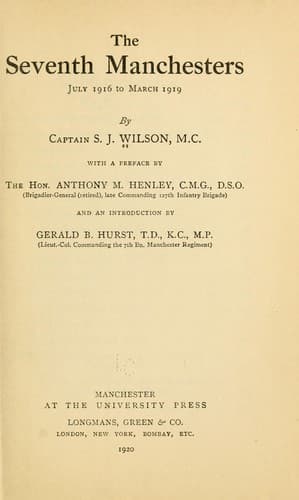
The Seventh Manchesters: July 1916 to March 1919Wilson, S. J.
History
The Seventh Manchesters: July 1916 to March 1919
Wilson, S. J.
Great Britain. Army. Manchester Regiment. Battalion, 7th (Territorial); World War, 1914-1918 -- Regimental histories -- Great Britain
After a final effort in the late afternoon to advance against our
positions in a line of small sections, which was met with the usual
devastating fire, the enemy gave it up and occupied the remaining hours
of daylight with fierce shelling. Our heavy artillery had at last
returned and got to work and their shelling began to have effect, for it
was noticeable that the Boche shells were now arriving from a greater
distance than formerly. The 6th had an exciting episode that day. A
party of courageous Germans, led by an officer, had pushed forward and
were throwing bombs amongst them. Lieut. Mall decided this must be
stopped, and he led one platoon over in a short sharp charge. Fifteen
Huns were bayonetted, and Mall returned triumphantly with the officer
and one man as prisoners. They proved to be Jaegers, and although the
officer told us nothing the man was very voluble. It was some comfort to
find that of one fresh battalion that had entered Ablainzevelle, about
forty only remained. A couple of packets of Woodbines were found in the
pockets of the officer--loot from the canteen at Achiet-le-Grand. The
soldier told us that this form of German enterprise was reserved for the
officers.
This day, March 28th, marked the end of the heavy fighting. The German
thrust had been checked, and the effort to reach the Coast had failed. A
glance at the map will show that, had the advance continued here the
Arras position would have been seriously threatened, and the Germans
would have been well on their way to Abbeville and the Channel Ports.
That night the 7th were overjoyed to hear that they were to be relieved.
The L.F's. took over the brigade sector, but the relief had been ordered
so suddenly that there was no time for reconnaissance, with the result
that it was almost dawn before the last platoon of the battalion had
struggled over the crest line to the old system of trenches 1,500 yards
further back in dead ground. Heavy rain, during the evening had
converted these neglected trenches into veritable ditches of mud. A few
cubby holes had been constructed by the previous occupants, and filled
with mud though they were, our men dropped into them and fell fast
asleep. It was the first undisturbed sleep they had had for nearly a
week, a period which had seemed more like a month. During the afternoon
the battalion received orders to furnish a billeting party which had to
proceed to Gommecourt. Billeting--this was indeed bliss. They received a
rude shock on arrival however to find that the word was a misnomer. We
were to relieve the 15th Hampshires of the 41st division, who had just
been hurried back from Italy. They occupied trenches on the edge of
Gommecourt village in support to the front line, which was only about
400 yards away. The astonishment of the battalion on arrival about 3
a.m., on March 30th, when they found the nature of their new
headquarters, can be easily imagined. They were indeed "fed up"--back to
Public-domain text, read in full here on John Shaqi.
Reviews
Reviews
No reviews yet
Be the first to share your thoughts on this work.
Elsewhere in the archive
Join the Discussion
Join the discussion
Sign in to leave a comment or review.
Sign InorCreate an account