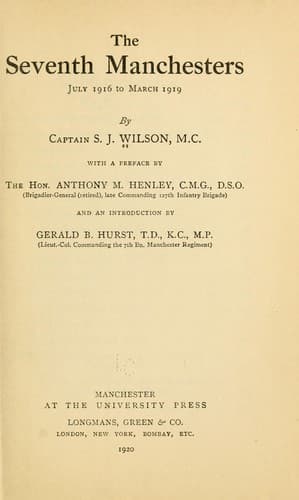
The Seventh Manchesters: July 1916 to March 1919Wilson, S. J.
History
The Seventh Manchesters: July 1916 to March 1919
Wilson, S. J.
Great Britain. Army. Manchester Regiment. Battalion, 7th (Territorial); World War, 1914-1918 -- Regimental histories -- Great Britain
When the brigade went into the line again it was to take over the sector
to the right of Hebuterne on the ridge previously mentioned. The most
important feature about this part of the line was La Signy Farm, which
lay just below the crest on the eastern side of the ridge. The ruins of
the farm building were in Boche hands, but the eastern side of the five
hundred yards square hedge that surrounded the grounds ran along our
front line. North of the grounds our line was echeloned forward and then
ran due north to the corner of Hebuterne. Skeletons of large trees stood
up like tall sentinels over the piles of bricks and stones which had
once made up the farm buildings. At the farthest corner of the hedge was
a shell-pitted patch of ground in a slight depression marked on the map
as Basin Wood. This was known to be honeycombed with deep dug-outs and
galleries and was therefore a frequent target for our heavy howitzers.
Further south the two opposing lines were almost parallel as far as the
vicinity of Watling Street--then a Boche trench. In the dead ground
behind our line was Euston Dump, which had gone up with a tremendous
roar in the early days of the March fighting, leaving a large hole.
Stoke's mortar shells, "footballs," etc., were scattered about in all
directions. Not far away from here was the Sugar Factory, which, from
the attention it received, the Hun regarded as more important than we
did.
The C.O. maintained his policy of worrying the Hun in every possible
manner, the fullest use being made of the artillery liaison officers and
the Stokes and Newton trench mortars for this purpose. Every night
little strafes were planned which must have kept Fritz in a constant
state of speculation as to what might happen next. To assist in these
annoying tactics a special company of R.E., whose particular devilry was
gas, came up and dug in 1,000 gas projectiles behind the support lines.
On two separate nights, after everything had been considered favourable,
they gleefully let them off at La Signy Farm and its environs, and then
disappeared down their dug-outs to gloat over the picture of choking and
writhing Huns. We consoled ourselves with the probability that the enemy
had sustained more casualties than we had.
On July 8th Corps had a sudden recurrence of "attackitis," and,
doubtless at the instigation of a junior intelligence officer, they sent
out a frantic request to "all whom it may concern" to ascertain who the
enemy were in front. They had feared a relief by large German soldiers
who were anxious to smell the blood of the Hated English. This message,
or an adulterated form of it, filtered "through the usual channels" and
so reached the 7th in the late afternoon. Two hours before darkness it
had been answered in the following manner.
Public-domain text, read in full here on John Shaqi.
Reviews
Reviews
No reviews yet
Be the first to share your thoughts on this work.
Elsewhere in the archive
Join the Discussion
Join the discussion
Sign in to leave a comment or review.
Sign InorCreate an account