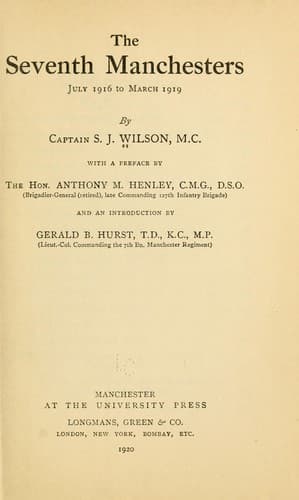
The Seventh Manchesters: July 1916 to March 1919Wilson, S. J.
History
The Seventh Manchesters: July 1916 to March 1919
Wilson, S. J.
Great Britain. Army. Manchester Regiment. Battalion, 7th (Territorial); World War, 1914-1918 -- Regimental histories -- Great Britain
We lost Padre Hoskyns at this period. He had received an order which
filled him with chagrin to report for duty as Senior Chaplin to the 6th
division, so he journeyed at once to the divisional H.Q. and told the
major-general he would sit on his doorstep until he got permission from
him to stay with the battalion. Efforts were made but they were of no
avail, and a more peremptory order than the last was received, so he
took a sorrowful farewell and departed, followed by the regrets of the
whole battalion, and indeed of a good number of the division. "Some have
greatness thrust upon them," was applicable in his case, for he had not
sought promotion but preferred to remain a "parish priest" and live
amongst the men. Much the same remark applied to the C.O. who, in the
absence of General Henley at Divisional Headquarters, was called upon
to take command of the brigade during the succeeding weeks, for he
always expressed his preference for battalion work. Owing to the fact
that Major Rae was in hospital at this time with the "flue," Capt.
Creagh assumed command of the battalion, and Lt. Barratt being on a
month's leave in England, Lt. Wilson was temporarily appointed Adjutant.
Capt. Palmer, an old officer of the 7th, who had been carrying out
important work in England since his recovery from a wound obtained in
Gallipoli on June 4th, returned to us some weeks previous to this and
was put in command of "C" company.
During our period in reserve the 126th brigade had continued our
worrying tactics and had attempted to raid La Signy Farm. They found the
place strongly held, however, and after repeated efforts to get to the
Hun positions had been forced to abandon the attempt. When we took over
the front line from the 10th Manchesters for a continuous spell of
sixteen days, we found that we were expected to co-operate at once in a
forward movement with the New Zealanders, who were in the Hebuterne
sector, and who intended to occupy a shorter line across the valley. The
first day, July 19th, found us making preparations for this operation at
express speed ready for evening. Lieut. Edge, an old second line
officer, was put in charge of a party supplied by "C" company, and they
were expected to capture and hold a Boche post about 500 yards away. It
was decided that the silent method would be the best, so artillery
support was declined. Edge displayed consummate skill and patience in
carrying out this hazardous enterprise, and his difficulties were not
lessened by disturbing events on both flanks. All along the New Zealand
front, from Hebuterne to Rossignol Wood, an advance was taking place,
while immediately on the left the 6th were moving forward and in the
process had met with considerable resistance so that a pitched battle
had arisen. To add to the troubles the Naval Division on our right had
selected this night for a raid near Beaumont Hamel, accompanied with
noise, with the result that the Hun put down his protective barrage all
along our ridge.
Public-domain text, read in full here on John Shaqi.
Reviews
Reviews
No reviews yet
Be the first to share your thoughts on this work.
Elsewhere in the archive
Join the Discussion
Join the discussion
Sign in to leave a comment or review.
Sign InorCreate an account