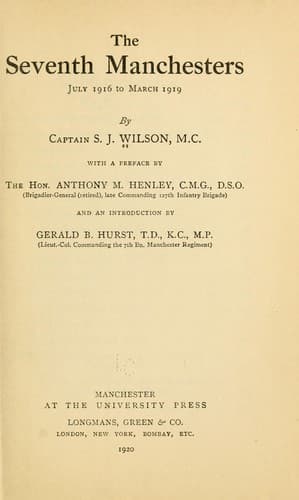
The Seventh Manchesters: July 1916 to March 1919Wilson, S. J.
History
The Seventh Manchesters: July 1916 to March 1919
Wilson, S. J.
Great Britain. Army. Manchester Regiment. Battalion, 7th (Territorial); World War, 1914-1918 -- Regimental histories -- Great Britain
The division expected to cover, in the first day's fighting, the large
mass of high ground which is flanked on its western edge by Serre and
overlooks Miraumont on the eastern side. A Prussian division was known
to be defending this part of the line. The 7th were to take part in the
initial assault in the right brigade sector, while the 125th brigade
were on the left. A thick mist enshrouded the land in the early morning
of August 21st, and doubtless many men on both sides thought of the
similar conditions which prevailed on the 21st of another month when the
Hun attacked with such terrible results. Here was the revenge and it was
to take place, curiously enough, under like circumstances. At 4.50 a.m.
the attack commenced, preceded by a short but destructive barrage over
the enemy position. For the Fleur de Lys "C" and "D" companies led off,
their objective being a part of the sunk road running across the front
from Puisieux to Beaumont Hamel. It was impossible to see more than
forty yards, and this rendered control by the officers practically out
of the question. The section commanders, however, in many cases
Lance-Corporals and even privates, rose magnificently to the occasion,
with the result that touch was maintained and the direction of advance
preserved. Short, sharp struggles took place at various points, but the
Boche were overpowered, and eventually a good line was established on
the objective. "C" company lost 2nd-Lt. Harland, M.C., and Lt.
Lofthouse, both wounded, while "D" company, although keeping their
officers, had Sgt. W. Brown killed.
The next phase of the battle comprised the attack of "A" and "B"
companies who passed through the first objectives and advanced to the
top of the ridge. Lieut. H. N. Kay of "B" company was shot dead at close
range during the clearing of a dug-out in the early stages of this
fight, while later on this company suffered heavy casualties, Sgt.
Green, D.C.M., M.M., being killed and Sgts. Guttery and Gleeson wounded.
On reaching the final objective Lt. Douglas carried out work of the
greatest value in the organisation of his company. In spite of the
strongly increasing enemy shell-fire he moved about amongst his men with
such coolness and disregard for personal danger that his example
inspired the men for the strong counter attacks which later took place.
For his splendid leadership and initiative he was afterwards awarded the
Military Cross. Capt. Grey Burn and his company on the right were having
an awkward time from enemy snipers, but he organised his now small
numbers very carefully, and personally kept the enemy under close
observation. Seeing an enemy concentration in progress, evidently for a
counter-attack, he quickly gave information, and the gunners were able
to disperse the enemy with a very effective barrage.
Public-domain text, read in full here on John Shaqi.
Reviews
Reviews
No reviews yet
Be the first to share your thoughts on this work.
Elsewhere in the archive
Join the Discussion
Join the discussion
Sign in to leave a comment or review.
Sign InorCreate an account