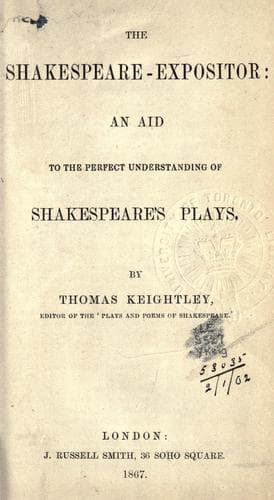
The Shakespeare-Expositor: An Aid to the Perfect Understanding of Shakespeare's PlaysKeightley, Thomas
General
The Shakespeare-Expositor: An Aid to the Perfect Understanding of Shakespeare's Plays
Keightley, Thomas
Drama -- Outlines, syllabi, etc.; Shakespeare, William, 1564-1616 -- Outlines, syllabi, etc.
'Brach' cannot be right; for brach was bitch (see Index _s. v._), and
what sportsman would say Bitch Sweet lips, for instance, of one of his
hounds? In the usual manner the printer was led away by the 'brach' in
the following line. The original word must have been a verb, and, were
we not aware of what critics usually are, we might wonder at Johnson's
most simple and natural emendation, _Bathe_ not being universally
adopted. In his whole speech the lord shows his affection for his
hounds; for the charge about coupling Clowder with another hound is
evidently owing to his being united to an ill-conditioned dog. Poor
Merriman, it is plain, had got a swelling in the leg or elsewhere--for
that is the only possible meaning of 'emboss'd' in this place; so when
the Prince (1 Hen. IV. iii. 3) calls Falstaff an "_embossed_ rascal,"
he means swollen up--the proper remedy for which was _bathing_ or
fomenting with warm water; and this he directs to be done. But Mr.
Collier tells us that "a _dog_ or a deer is said to be _embossed_ when
fatigue makes them foam at the mouth;" from which all that can be
inferred is that Mr. Collier is no sportsman; for any one who has been
out with hounds knows that when fatigued they pant and put out their
tongues, but _never_ foam. Shakespeare, who apparently knew something
of hunting, has correctly, "_Lolling_ the tongue with slaughtering"
(Cymb. v. 3), alluding to hounds. On the other hand, Mr. Dyce most
confidently reads _Trash_, _i.e._, put a "heavy collar, strap or rope
dragging loose on the ground" on him to check his speed. I fear that
Mr. Dyce is no sportsman either. At least at the present day hounds do
not carry weight; for that, I suppose, is what he means. He probably
understood 'emboss'd' in the same sense as Mr. Collier. I adopt
Johnson's reading, though aware that in cases of this kind (Introd. p.
65) we should not look for any similarity of form (Mr. Dyce's _ductus
literarum_) in the word to be substituted. (See on Othel. iii. 3.)
Here, for example, we might read _Mind_, or some other word.
* * * * *
"And when he says _what_ he is say that he dreams."
* * * * *
SC. 2. "And not a tinker, nor Christopher_o_ Sly."
* * * * *
"Madam wife, they say that I have dreamed _here_."
ACT I.
SC. 1. "Pisa, renowned for grave citizens,
Gave me my being, and my father first,
A merchant of great traffic through the world,
Vincentio[s] come of the Bentivoglii.
Vincentio's son, brought up in Florence,
It shall become to serve all hopes conceiv'd," etc.
Public-domain text, read in full here on John Shaqi.
Reviews
Reviews
No reviews yet
Be the first to share your thoughts on this work.
Elsewhere in the archive
Join the Discussion
Join the discussion
Sign in to leave a comment or review.
Sign InorCreate an account