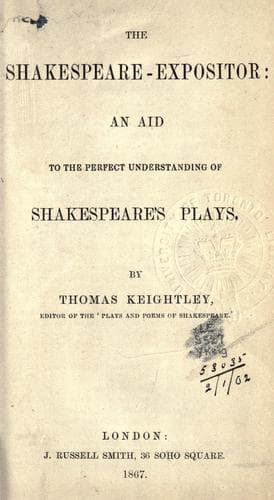
The Shakespeare-Expositor: An Aid to the Perfect Understanding of Shakespeare's PlaysKeightley, Thomas
General
The Shakespeare-Expositor: An Aid to the Perfect Understanding of Shakespeare's Plays
Keightley, Thomas
Drama -- Outlines, syllabi, etc.; Shakespeare, William, 1564-1616 -- Outlines, syllabi, etc.
"Our own stars all our fortunes,
Which, as we _sway_ 'em, to abuse or bless us."
Fletch. Chances, ii. 3.
It seems evident that the initial _s_ of _sway_ was effaced, a thing
not unusual. As to the change of _y_ to _g_, I lately read a work on
South America, in which the well-known name _Almagro_ was invariably
printed _Almayro_. 'Cry Hem!' may mean, use the language of rakish
youths; "Our watch-word was, Hem boys!" (2 Hen. IV. iii. 2).
* * * * *
"Some of us would lie low.--Who _is it_ wrongs him?"
* * * * *
"Gentlemen both, we will not wake your patience."
The meaning of 'wake' is not clear; perhaps we should read _task_.
Hanmer read _rack_; Talbot _waste_.
* * * * *
"I cannot bid you bid my daughter live."
A printer's error, probably caused in the usual way. We might better
read _make_, though 'bid' makes sense. 'Can I _make men live_ whe'r
they will or no?' (2 Hen. VI. iii. 3.)
* * * * *
"I do embrace your offer, and dispose
From henceforth of poor Claudio."
It would seem that something had been lost at the end, the speech
terminates so abruptly. We might supply _at your pleasure_.
* * * * *
"Have you been deceived; _for_ they swore you did."
Mr. Dyce would read '_for_ they _did swear_'; but the two _did_s rather
offend the ear.
* * * * *
"Brave punishments for him. _Come_, strike up, piper."
MERRY WIVES OF WINDSOR.
ACT I.
SC. 1. "The Council shall hear _of_ it; it is a riot."
The metre requires _of_, which makes the expression more idiomatic. Sir
Hugh naturally omits it.
* * * * *
"And I thank you always with my heart la!"
The folio reads '_love_ you'; the correction is Farmer's. So also in
Shallow's next speech.
* * * * *
SC. 3. "The good humour is to steal at a minute's rest."
As "_minim's_ rest" occurs in Rom. and Jul. ii. 1, Langton and
Collier's folio would so read here; but it may be, and probably is, a
mere blunder of Nym's.
* * * * *
"He hath studied her well, and translated her well."
The folio reads _will_; in both places the 4tos have 'well' in the
first, and omit it in the last.
* * * * *
"Hold, sirrah, bear you these _two_ letters tightly."
* * * * *
"For the revolt of mine is dangerous."
For 'the' we must, with Pope, read _this_. We have, "For this revolt of
thine" (Hen. V. ii. 1). Theobald, whom some critics follow, read _mien_
for 'mine,' which I utterly reject. (See on Two Gent. ii. 4.) I do not
think 'revolt' occurs anywhere in the sense of mere change.
ACT II.
Public-domain text, read in full here on John Shaqi.
Reviews
Reviews
No reviews yet
Be the first to share your thoughts on this work.
Elsewhere in the archive
Join the Discussion
Join the discussion
Sign in to leave a comment or review.
Sign InorCreate an account