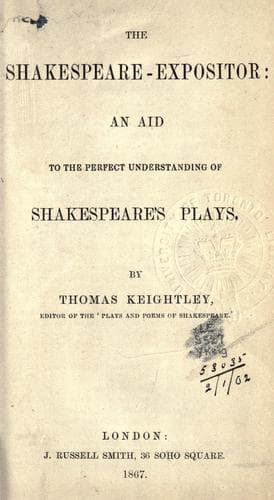
The Shakespeare-Expositor: An Aid to the Perfect Understanding of Shakespeare's PlaysKeightley, Thomas
General
The Shakespeare-Expositor: An Aid to the Perfect Understanding of Shakespeare's Plays
Keightley, Thomas
Drama -- Outlines, syllabi, etc.; Shakespeare, William, 1564-1616 -- Outlines, syllabi, etc.
No one has been able to make any sense of 'orphan-heirs,' which may
therefore be treated as a corruption. Warburton read '_ouphen_-heirs,'
which Singer adopts; but there is no such word as _ouphen_. My own
opinion is that the poet wrote _ouphes and_ heirs; and as in general
the _d_ in _and_ is not pronounced, even before vowels, and the _ou_
might easily be mistaken for _or_, the printer made _orphan_. The line,
we may see, thus forms a parallel to the preceding line. The poet seems
to have used 'heirs' in the sense of children. In Fletcher's Mad Lover
we have,
"Coarse and base appetites, earth's mere inheritors,
And _heirs_ of idleness and blood." (ii. 1.)
In favour of my reading, it may be observed that in iv. 4 and in the
following speeches the Ouphes occur, as well as the Elves and Fairies,
and nowhere else in Shakespeare.
* * * * *
"Elves list your names. Silence, you airy toyès.
Cricket to Windsor chimneys shalt thou leap;
What fires thou findest unraked and hearths unswept."
The rime shows that 'toyès' is a dissyllable. In 'unswept' the _t_
should not be sounded, and, I think, not be printed. _Unswep_ is
merely the apocopated part, of which examples are so numerous in our
language; it is like _kep_, _crep_, etc., which, though regarded now as
vulgarisms, are grammatically correct. Collier's folio, followed by Mr.
Collier and others, reads '_when_ thou_'st_ leap_'d_,' a mere result of
ignorance of grammar.
* * * * *
"And turn him to no pain."
From what precedes, we might conjecture _burn_.
* * * * *
"To repay that money will be a biting affliction."
I have, after Theobald, added here from the 4tos the following lines,
of which, however, he did not give the last:--
"_Mrs. Ford._ Nay, husband, let that go to make amends,
Forgive that sum and so we'll all be friends.
_Ford._ Well, here's my hand; all is forgiven at last.
_Fal._ It hath cost me well. I've been well pinch'd and wash'd."
The play is thus made to end more agreeably, and Falstaff can accept
the invitation to supper with a better grace. These lines, it is true,
rime, and so are not quite in harmony with the other speeches, whence
it seems to follow that the omission was made by the poet. But his
judgement in this case must have fallen asleep; for Ford had no right
to be so hard on the poor knight, as he had given him the money, or
rather we might say forced it on him. As to the rime, we have two other
couplets toward the end of the play.
TWELFTH NIGHT.
ACT I.
SC. 1. "Oh! it came o'er my ear like the sweet sound
That breathes upon a bank of violets."
Public-domain text, read in full here on John Shaqi.
Reviews
Reviews
No reviews yet
Be the first to share your thoughts on this work.
Elsewhere in the archive
Join the Discussion
Join the discussion
Sign in to leave a comment or review.
Sign InorCreate an account