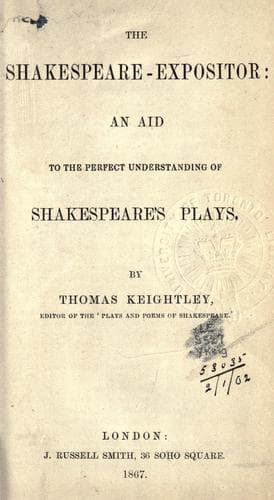
The Shakespeare-Expositor: An Aid to the Perfect Understanding of Shakespeare's PlaysKeightley, Thomas
General
The Shakespeare-Expositor: An Aid to the Perfect Understanding of Shakespeare's Plays
Keightley, Thomas
Drama -- Outlines, syllabi, etc.; Shakespeare, William, 1564-1616 -- Outlines, syllabi, etc.
"Alas! our frailty is the cause, not we;
For such as we are made, if such we be."
For 'if,' which is undoubtedly wrong, Tyrwhitt, followed by Steevens
and others, read _of_, which would seem to be confirmed by,
"For we are soft, as our complexions are."
M. for M. ii. 4.
"Such as our atoms were, even such are we."
Dryden, Wife of Bath's Tale.
I have printed my own conjecture _e'en_. Hanmer read _ev'n_, and yet
Tyrrwhitt probably was right, _frailty_ being meant.
* * * * *
"And I, poor monster, fond as much on him;
And she, mistaken, seems to doat on me."
I quite agree with Mr. Dyce in reading _As_ for 'And' in the second
line. These words are confounded even at the present day.
* * * * *
SC. 3. "I had such a leg; and so sweet a breath to sing."
I suspect 'leg'; for what has it to do here? and Sir Andrew had already
praised his own leg.
* * * * *
SC. 4. "_Go_ seek him out, and play the tune the while."
* * * * *
"More longing, wavering, sooner lost and worn."
In Mer. of Ven. i. 4, the folio reads 'well-_worn_ thrift' for the
'well-_won_ thrift' of the 4to. Hanmer was therefore right in reading
here _won_, the usual concomitant of 'lost.'
* * * * *
"Give me now leave to leave thee."
As it is the Clown that goes away, we should perhaps transpose the
pronouns, 'Give' being I give. Mr. Dyce, however, says the text is
right, it being "a courteous form of dismissal," to which explanation I
see no objection.
* * * * *
"It cannot be so answered.--Sooth, but you must."
The reply proves that 'It' should be _I_, as Hanmer corrected.
* * * * *
SC. 5. "Wind up my watch or play with my ... some rich jewel."
This punctuation of Mr. Collier's is excellent.
* * * * *
"Though our silence be drawn from us with cars."
For 'cars we might perhaps read 'car-' or 'cart-_ropes_.' In iii. 1. we
have drawing with "oxen and _wain-ropes_." Hanmer read _by the ears_,
S. Walker _racks_.
* * * * *
"Her _C_s, _U_s, and her _T_s, _and P_s! Why that?"
* * * * *
"Souter will cry upon it, for all this, though it be as rank as a fox."
We should probably read 'be _not_.' Hanmer read _ben't_.
* * * * *
"I will not give my part of this sport," etc.
It might appear better to read _would_; but all is right.
"I will not lose the part I hope to share
In these his fortunes for my patrimony."
Jonson, Sejanus, v. 10.
ACT III.
SC. 1. "And fools are as like _to_ husbands as pilchards are to
herrings."
Public-domain text, read in full here on John Shaqi.
Reviews
Reviews
No reviews yet
Be the first to share your thoughts on this work.
Elsewhere in the archive
Join the Discussion
Join the discussion
Sign in to leave a comment or review.
Sign InorCreate an account