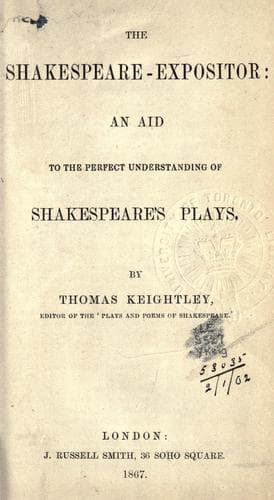
The Shakespeare-Expositor: An Aid to the Perfect Understanding of Shakespeare's PlaysKeightley, Thomas
General
The Shakespeare-Expositor: An Aid to the Perfect Understanding of Shakespeare's Plays
Keightley, Thomas
Drama -- Outlines, syllabi, etc.; Shakespeare, William, 1564-1616 -- Outlines, syllabi, etc.
Both sense and metre require _so_, given in Collier's folio.
* * * * *
SC. 2. "When in Bohemia
You take my lord, I'll give him my commission
To let him there a month behind the gest
Prefix'd for his parting."
The third line has apparently no sense. The critics say 'let' is
detain; but no instance of its use in that sense is to be found. We
might read _sit_, which occurs in the sense of stay, dwell, live,
as "I sit at ten pounds a week" (Mer. Wives, i. 3); and we have "and
_sit him_ down and die" (2 Hen. IV. iii. 1). We might also, and still
better, read _set_, which has nearly the same sense, settled, seated:
"Being unarm'd and _set_ in secret shade" (F. Q. vi. 3, 8). "Whoever
shoots at him, _I set him there_" (All's Well, iii. 2). In Fletcher's
Nice Valour (iv. 1) Heath, followed by Dyce, reads _sets_ for 'lets'
in "That lets it out, only for show or profit." 'Gest' (from _giste_,
_gîte_, Fr.?) is used of the halting-places on a royal progress. Singer
quotes from Strype a request from Cranmer to Cecil, "to let him have
the new-resolved upon _gests_ from that time to the end, that he might
know from time to time where the king was." Hence it would appear
that there was a program of the gests, stating the time of arrival at
and departure from each of them. I have therefore read 'gest-day,'
supposing the last word, as usual, to have been effaced. See Introd. p.
58.
* * * * *
"What lady she her lord."
I read _soe'er_ for 'she.' "What bloody work _soe'er_" (Othel. iii. 3).
* * * * *
"The doctrine of ill-doing nor dream'd _we even_."
The usual reading is '_no_ nor,' that of the 2nd folio.
* * * * *
"Of my young play-fellow.--_Good_ grace to boot!"
* * * * *
"You may ride us
With a soft kiss a thousand furlongs ere
With spur we heat an acre."
The phraseology here is evidently that of the race-course, where a
_heat_ is a race. I read 'we heat _us_.' The phrase is elliptic, the
full phrase being 'We heat us by running over an acre of ground.'
* * * * *
"May it be?--
Affection! thy intention stabs the centre."
So I would point, with Steevens; in the folio it is "May it be
affection?" The whole passage is rather obscure. 'Affection' is
imagination, fancy (see Index _s. v._); and the meaning seems to be
that it stretches to (expressed by intention), and stabs, or pierces,
even the centre of the earth.
* * * * *
"Looking on the lines
Of my boy's face methought I did recoil
Twenty-three years."
The folio reads 'methoughts,' and a MS. correction, followed by Mr.
Collier, _my thoughts_; but 'recoil' is always a neuter verb in
Shakespeare.
* * * * *
Public-domain text, read in full here on John Shaqi.
Reviews
Reviews
No reviews yet
Be the first to share your thoughts on this work.
Elsewhere in the archive
Join the Discussion
Join the discussion
Sign in to leave a comment or review.
Sign InorCreate an account