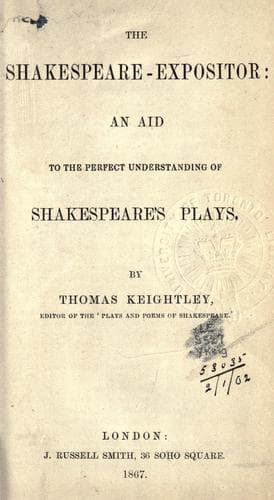
The Shakespeare-Expositor: An Aid to the Perfect Understanding of Shakespeare's PlaysKeightley, Thomas
General
The Shakespeare-Expositor: An Aid to the Perfect Understanding of Shakespeare's Plays
Keightley, Thomas
Drama -- Outlines, syllabi, etc.; Shakespeare, William, 1564-1616 -- Outlines, syllabi, etc.
"You did mistake,--_No_, no, if I mistake."
* * * * *
"I would land-damn him."
As 'land-damn' seems to be an unknown term, it might be better to read,
with Collier's folio, _lamback_, derived perhaps from _lambiccare_, It.
There is also a vulgar term _lambaste_. 'Damn' was probably suggested
by the same word in the preceding line.
* * * * *
SC. 3. "We have always truly served you and beseech _you_."
* * * * *
"They have been absent. 'Tis good speed, _and_ foretells."
We might also read _it_; or, with Pope, '_This_ good speed.'
ACT III.
SC. 2. "This sessions--to our great grief we pronounce _it_."
* * * * *
"To prate and talk for life and honour 'fore
Who please to come and hear."
We might be inclined to read _plead_ for 'prate'; but no change is
required.
* * * * *
"Since he came
With what encounter so uncurrent I
Have strain'd to appear thus."
I read 'have I Strain'd to appear thus?' in which I had been
anticipated by Hanmer. An 'uncurrent encounter' was an unusual kind of
meeting; and 'strain'd' signifies pulled against the line of my duty as
a wife--a metaphor taken from dogs in a leash--
"What I was I am,
More _straining_ on for plucking back, not following
My leash unwillingly" (iv. 3).
It might also signify, acted indecorously, "Unless he know some
_strain_ in me that I know not myself." Merry Wives, ii. 1.
* * * * *
"You will not own it.--More than _I am_ mistress of."
So also Hanmer corrected.
* * * * *
"Thy brat hath been cast out, like to itself,
No father owning it."
If we read '_left_ to itself' we might get better sense.
* * * * *
"But yet hear this; mistake me not. No! life--
I prize it not a straw.... But, for mine honour."
So we may best punctuate, with Hanmer. We might perhaps read '_For_
life,' as above.
* * * * *
"Which you knew great, and to the hazard _boldly_."
The 2nd folio reads '_certain_ hazard.'
* * * * *
"What studied torments, tyrant, hast _thou_ for me?
What wheels? _what_ racks? _what_ fires? what flaying, boiling,
In leads or oils?"
See above, i. 2. Introd. p. 55.
* * * * *
"Who is lost too. Take your patience to you, _sir_."
* * * * *
SC. 3. "Which may, if Fortune please, both breed thee, pretty _one_."
So Rowe also.
* * * * *
"A boy or a child, I wonder."
Public-domain text, read in full here on John Shaqi.
Reviews
Reviews
No reviews yet
Be the first to share your thoughts on this work.
Elsewhere in the archive
Join the Discussion
Join the discussion
Sign in to leave a comment or review.
Sign InorCreate an account