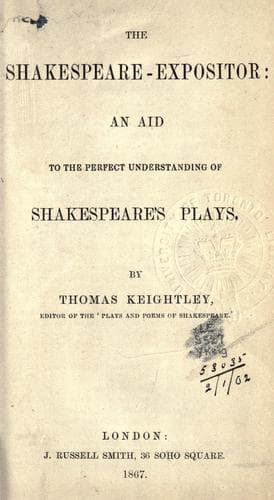
The Shakespeare-Expositor: An Aid to the Perfect Understanding of Shakespeare's PlaysKeightley, Thomas
General
The Shakespeare-Expositor: An Aid to the Perfect Understanding of Shakespeare's Plays
Keightley, Thomas
Drama -- Outlines, syllabi, etc.; Shakespeare, William, 1564-1616 -- Outlines, syllabi, etc.
The editors in general read, with Malone, _she'd_ for 'should'; but
surely she was not the balance. We get very good sense by omitting
either 'at' or 'o'; in my Edition I have, as Pope had done, omitted the
latter; for _o_', or _of_, was sometimes added by the printers. (See on
M. for M. iv. 4.) 'Weigh'd' is pondered.
* * * * *
"Boürn _or_ bound of land, tilth, vineyard, none."
Editors have taken strange liberties with the whole of this passage.
Here they omit 'Bourne.'
* * * * *
"Will you laugh me asleep? for I am very heavy.--
Go sleep, and hear us _not_."
It is very strange that none of the editors should have seen that the
negative had been effaced or omitted. Surely the very last thing that
Antonio could have wished was that he should hear them; and how could
he if he went to sleep? _Not_, we may also see, is required by the
metre. The latter part may be a half-aside.
* * * * *
"I am more serious than my custom, you
Must be so too; if _you_ heed me; which to do."
* * * * *
"The setting of thine eye and cheek proclaim_s_."
* * * * *
"Which throes thee much to yield.--Thus, sir."
Perhaps to complete the measure and improve the sense we should add, _I
say_. The folio spells 'throes' _throwes_.
* * * * *
"Be rough and razorable; she that from whom
We all were sea-swallow'd, though some cast again--
And by that destiny--to perform an act."
Though in my Edition I have not altered the text, I think we should
read 'from whom _coming_' with Singer; 'we were all,' and 'cast _up_.'
Musgrave proposed 'destin'_d_,' which is probably right. Rowe, followed
by the other editors, omitted 'that' in the first line.
* * * * *
"Twenty consciences
That stand 'twixt me and Milan, candied be they
And melt ere they molest!"
I must confess I do not clearly understand this passage. Surely as he
was, as he had just said, in actual possession of Milan, his conscience
could not 'stand' between him and it. Perhaps, however, we are to view
'stand' as in the conjunctive mood, and expressing a condition. Neither
do I see clearly the meaning of 'candied' and 'melt' in this place.
* * * * *
"That's verily. 'Tis best we stand upon our guard."
Pope's reading, _verity_, is most certain. "'Tis _verity_, I assure
you" (Mass. New Way, etc. i. 1).
* * * * *
SC. 2. "And another tempest _a_ brewing."
* * * * *
"Young scamels from the rock."
Public-domain text, read in full here on John Shaqi.
Reviews
Reviews
No reviews yet
Be the first to share your thoughts on this work.
Elsewhere in the archive
Join the Discussion
Join the discussion
Sign in to leave a comment or review.
Sign InorCreate an account