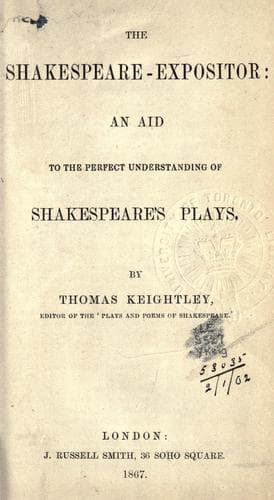
The Shakespeare-Expositor: An Aid to the Perfect Understanding of Shakespeare's PlaysKeightley, Thomas
General
The Shakespeare-Expositor: An Aid to the Perfect Understanding of Shakespeare's Plays
Keightley, Thomas
Drama -- Outlines, syllabi, etc.; Shakespeare, William, 1564-1616 -- Outlines, syllabi, etc.
SC. 4. "So by a roaring tempest, on the flood
A whole armado of convicted sail," etc.
For 'convicted' I read _conflicted_, i.e. dashed, or dashing together.
We have "_conflicting_ wind and rain" (Lear, iii. 1), "_conflicting_
elements" (Tim. iv. 3). It seems more probable than any of the various
corrections proposed.
* * * * *
"No scope of Nature, no distempered day."
I adopt Pope's reading, _'scape_.
* * * * *
"Strong reasons make strong actions."
So 2nd folio properly reads; the 1st has '_strange_ actions.'
ACT IV.
SC. 1. "Can you not read it? is it not fair_ly_ writ?"
The reply proves that we should read so.
* * * * *
"And quench this fiery indignation."
The context shows that 'this' should be _his_.
* * * * *
SC. 2. "Doth make a stand at what your Highness will_s_."
* * * * *
"And more, more strong then lesser, is my fear."
I read '_in_ my fear.' We have _Is_ for _In_ also in Jul. Cæs. i. 3;
the same confusion of these words occurs more than once in Chaucer.
I have often met with it in books printed in the last century; and I
myself, in writing these Notes, have frequently confounded these words.
* * * * *
"If what in rest you have in right you hold,
Why then your fears--which, as they say, attend
The steps of wrong--should move you to mew up
Your tender kinsman," etc.
As it is plain, from what went before, that they should not have that
effect, editors have made a transposition of 'then' and 'should.'
It seems to me, however, that here, as in so many other places, the
printer omitted the negative after 'should.' I do not perfectly
understand 'rest' in the preceding line, but it may be tranquillity,
tranquil, undisturbed possession, a sense it bears in Scripture. See
Ps. xcv. 11, cxvi. 7.
* * * * *
"That you'_d_ have bid us ask his liberty."
* * * * *
"How oft the sight of means to do ill deeds
Makes ill deeds done!"
So also Capell and Collier's folio have transposed in the last line.
* * * * *
"As bid me tell my tale in express words."
For 'As' Pope read _Or_, Malone _And_.
* * * * *
"Thou art a murderer.--Do not prove me so;
Yet am I none."
For 'not,' which makes no sense, we should read _you_ or _but_. I
prefer the latter.
ACT V.
SC. 1. "Send fairplay orders and make compromise."
For 'orders' Collier's folio reads _offers_, which I have adopted.
* * * * *
SC. 2. "That we the sons and children of this isle
Were born to see so sad an hour as this."
For 'Were' the folio has _Was_, produced by 'isle.'
* * * * *
Public-domain text, read in full here on John Shaqi.
Reviews
Reviews
No reviews yet
Be the first to share your thoughts on this work.
Elsewhere in the archive
Join the Discussion
Join the discussion
Sign in to leave a comment or review.
Sign InorCreate an account