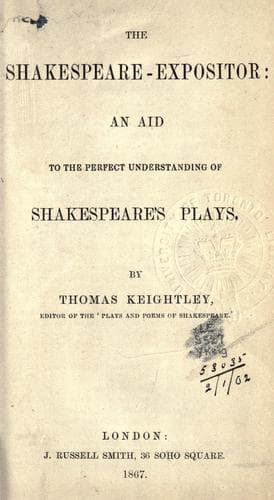
The Shakespeare-Expositor: An Aid to the Perfect Understanding of Shakespeare's PlaysKeightley, Thomas
General
The Shakespeare-Expositor: An Aid to the Perfect Understanding of Shakespeare's Plays
Keightley, Thomas
Drama -- Outlines, syllabi, etc.; Shakespeare, William, 1564-1616 -- Outlines, syllabi, etc.
For 'low, lie down,' Warburton read _lowly clown_. But it is of a
ship-boy the poet is speaking, and he would hardly make so sudden a
transition.
ACT IV.
SC. 1. "Led on by bloody youth, guarded with rage
And countenanc'd by boys and beggary."
There may be some doubt about 'bloody'; for 'rage' Sidney Walker and
Collier's folio read _rags_, which seems confirmed by the following
line.
* * * * *
"Turning your books to graves, your ink to blood."
For 'graves' Warburton and Hanmer read _glaives_, Steevens, _greaves_.
Neither of these words occurs in Shakespeare, and I rather suspect that
the poet's word was _braves_, _i.e._ bravadoes, boasts. "I will not
bear these _braves_ of thine" (Tam. of Shr. iii. 1). "Now where's the
Bastard's _braves_?" (1 Hen. VI. iii. 2).
* * * * *
"And are enforc'd from our most quiet there."
For 'there' Warburton read _sphere_; perhaps we might read _haven_.
But, as in Lear (i. 1) we have "Thou losest _here_ a better _where_ to
find," 'there' is probably the poet's word, both it, _here_ and _where_
being used as nouns signifying place.
* * * * *
"My brother-general the commonwealth ...
To brother-born a household cruelty
I make my quarrel in particular."
The second line is not in the folio, and there may be, as some critics
think, a line lost; but my punctuation removes all difficulty. We have
only to understand _makes his quarrel_; yet how strangely critics have
puzzled over this not very difficult passage! We should perhaps read
'generals'; for Hastings and Bardolph seem to have equal authority with
Mowbray. Lord Scroop had been put to death at Bristol, 1 Hen. IV. i. 3.
* * * * *
"And bless'd and grac'd, and did more than the king _affect_."
Thirlby conjectured _indeed_ for 'and did.' I rather think there was,
as usual, an effacement at the end of the line.
* * * * *
"Every thing set off
That might so much as think you enemies."
This is a strange use of 'think'; we should perhaps read _hint_, were
it not that this verb does not occur in Shakespeare.
* * * * *
"And present execution of our wills
To us and to our purposes confin'd."
For 'confin'd' Hanmer read _confirm'd_; Johnson, _consign'd_. I confess
I do not clearly understand the passage.
* * * * *
"That were our royal faiths martyrs in love."
Hanmer and Johnson read _loyal_; but Malone makes a good defence of
'royal.'
* * * * *
"No, no, my lord. Note this, the king is weary of
_Such_ dainty and such picking grievances."
I think it was thus the poet wrote, but that _such_ was effaced and
then 'of' transposed on account of the metre.
* * * * *
Public-domain text, read in full here on John Shaqi.
Reviews
Reviews
No reviews yet
Be the first to share your thoughts on this work.
Elsewhere in the archive
Join the Discussion
Join the discussion
Sign in to leave a comment or review.
Sign InorCreate an account