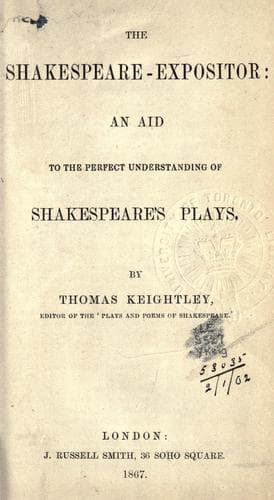
The Shakespeare-Expositor: An Aid to the Perfect Understanding of Shakespeare's PlaysKeightley, Thomas
General
The Shakespeare-Expositor: An Aid to the Perfect Understanding of Shakespeare's Plays
Keightley, Thomas
Drama -- Outlines, syllabi, etc.; Shakespeare, William, 1564-1616 -- Outlines, syllabi, etc.
This is the orthography of the folio; the 4tos read here _botled_, but
in iv. 4 as the folio. Now as _bottled_ has, as far as my knowledge
extends, but one sense, and one which would give no meaning here, it
may be intended to show that the verb comes from _bottel_ or _bottle_
in the sense of truss, bundle, as a bottle of hay or straw, a sense
which it retains in various compounds in the provincial dialects.
'Bottel'd spider' would then answer to 'bunch-back'd toad' a few lines
further on. If this should not satisfy, we might read _bloated spider_,
as in Cowper, Task. v. 442.
* * * * *
SC. 4. "Nay, I pr'ythee, stay a little; I hope my holy humour will
change."
This is the reading of the 4tos, which I prefer. The folio has
'passionate humour of _mine_.' The change, as Mr. Dyce says, was made
by the editors on account of the statute 3 Jac. I. 21.
* * * * *
"If two such murderers as yourselves came to you
Would not entreat for life? As you would beg
Were you in my distress...--
Relent! no, _no_; 'tis cowardly and womanish."
This punctuation gives, I think, the sense of the poet; and I am happy
to find I had been anticipated in it by Singer.
ACT II.
SC. 1. "And more to peace my soul shall part to heaven."
It might be better, though the meaning is the same, to read '_at_
peace,' as in the following line. The second 'to' was probably in the
printer's mind. The usual reading is '_in_ peace' which may be right.
* * * * *
SC. 2. "To his new kingdom of ne'er-changing night."
The more appropriate term, I think, would be _light_. Editors follow
the reading of the 4tos, 'of perpetual rest.'
* * * * *
"And may direct his course as _it_ please himself."
ACT III.
SC. 1. "Too late he died, that might have kept that title."
Surely it was too _soon_ or too _early_. This may, perhaps, be regarded
as an instance of the substitution of a contrary term. In the Faerie
Queen, however, we have "Saying, that harlot she _too lately_ knew" (i.
3. 25). "And knightly worth which he _too late_ did try" (Ib. iii. 9.
25). See Index, _s. v._ Too.
* * * * *
"I pray you, _gentle_ uncle, give me this dagger."
We might also read 'give _to_ me'; but it would sound rather stiff. The
usual reading is 'uncle _then_.'
* * * * *
"My lord, will it please you _to_ pass along?"
* * * * *
SC. 2. "My lord, I hold my life as dear as you do yours."
The folio omits 'you do' which is necessary for the sense, and is in
the 4tos.
* * * * *
SC. 3. "Make haste, the hour of death is expiate."
In Sonnet xxii. 'expiate' is also used in the sense of expired, ended.
Public-domain text, read in full here on John Shaqi.
Reviews
Reviews
No reviews yet
Be the first to share your thoughts on this work.
Elsewhere in the archive
Join the Discussion
Join the discussion
Sign in to leave a comment or review.
Sign InorCreate an account