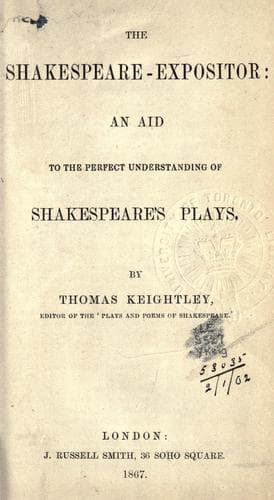
The Shakespeare-Expositor: An Aid to the Perfect Understanding of Shakespeare's PlaysKeightley, Thomas
General
The Shakespeare-Expositor: An Aid to the Perfect Understanding of Shakespeare's Plays
Keightley, Thomas
Drama -- Outlines, syllabi, etc.; Shakespeare, William, 1564-1616 -- Outlines, syllabi, etc.
Theobald, who is usually followed, read _bawds_ for 'bonds'; but surely
_bawds_ could not with any propriety be called 'sanctified and pious.'
The truth is, the poet's word was 'bonds,' but the editors have not
understood it, Singer, for example, calling it _nonsense_. The whole
passage is merely a poetic periphrasis of seduction under promise of
marriage; and had the word been _Sounding_, not 'Breathing,' there
would probably have been no mistake.
* * * * *
"Have you so slander any moment leisure."
Collier's folio reads _squander_, which may be right; but we have
"She slanders so her judgement" (Cymb. iii. 5), and "To slander music
any more than once" (Much Ado, ii. 3). In 'any moment leisure' the
structure is perfectly correct.
* * * * *
SC. 4. "The King doth wake to-night, and takes his rouse,
Keeps wassail, and the swaggering upspring reels."
Here 'wake' is like _watch_ (see Macb. ii. 2), sits up late. In the
next line I would for 'swaggering' read _staggering_. 'Upspring' is
probably used collectively for the risers from the table, a mode of
expression not yet obsolete. "The space was filled by the _in-rush_
before he had time to make his way out."--Mrs. Gaskell, Sylvia's
Lovers, ch. xii.
* * * * *
"The dram of eale
Doth all the noble substance, of a doubt
To his own scandal....--Look, my lord! it comes."
This passage is not in the folio. As in 4to 1604, where it occurs, we
have in ii. 1 'a deale' for 'a devil,' I here read _evil_ for 'eale';
in both cases _vi_ may have been written like _a_; and for 'of a
doubt,' which is to be found nowhere else, _out o' doubt_, or perhaps
'_out_ of a doubt:' some read _often dout_. The sentence, we may see,
is not complete, and it should also be recollected that the language of
the whole of the speech is involved, as if the speaker was thinking of
something else, and merely talking against time.
* * * * *
"Making night hideous and we fools of nature."
Grammar would require _us_ for 'we.'
* * * * *
SC. 5. "_Hear_ what?--I am thy father's spirit."
The repetition of _Hear_ from preceding line seems necessary. Omissions
of this kind are not unfrequent.
* * * * *
"And for the day confin'd to fast in fires."
Heath proposed _lasting_ for 'fast in,' but, I think, with a loss of
vigour, if a gain of correctness. 'Confin'd' may here signify limited,
restrained. See on M. for M. iv. 3.
* * * * *
"That roots itself in ease on Lethe wharf."
The folio reads _rots_, which Mr. Dyce adopts.
* * * * *
"Of life, of crown, of queen, at once despatch'd."
Public-domain text, read in full here on John Shaqi.
Reviews
Reviews
No reviews yet
Be the first to share your thoughts on this work.
Elsewhere in the archive
Join the Discussion
Join the discussion
Sign in to leave a comment or review.
Sign InorCreate an account