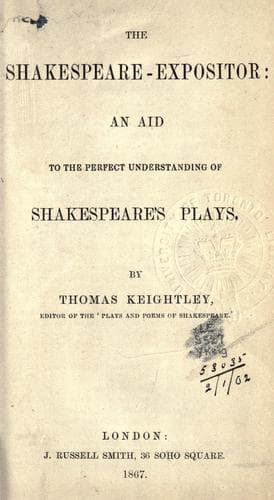
The Shakespeare-Expositor: An Aid to the Perfect Understanding of Shakespeare's PlaysKeightley, Thomas
General
The Shakespeare-Expositor: An Aid to the Perfect Understanding of Shakespeare's Plays
Keightley, Thomas
Drama -- Outlines, syllabi, etc.; Shakespeare, William, 1564-1616 -- Outlines, syllabi, etc.
This is hard to understand; but there is no reason to suspect any
corruption of the text. The allusion seems to be to the loud shrill
tones of the children in acting.
"Like to some boy, that acts a tragedy,
Speaks burly words and roars out passion."
Marston, Ant. and Mel. II. iv. 5.
* * * * *
"I know a hawk from a handsaw."
The proper word is _hernshaw_; but the phrase may, as was not unusual,
have undergone a change.
* * * * *
"The first row of the _Pons Chanson_ will show you more."
What '_Pons Chanson_' is, no one has divined. Editors therefore read
'pious chanson,' meaning the ballad of Jephtha and his daughter.
* * * * *
"May be the devil and the devil has power."
For the first 'the devil,' 4to 1604 reads _a deale_; so the reading was
probably 'a devil,' which is best.
ACT III.
SC. 1. "Niggard of question; but of our demands
Most free in his reply."
Warburton transposes 'niggard' and 'most free'; and certainly, unless
the poet forgot himself, he was by no means 'niggard of question';
and 'niggard' would also accord better than 'free' with 'of demands.'
It might be better to read _to_ for 'of,' as these words were often
confounded.
* * * * *
"Good gentlemen, give him a further edge."
Here 'edge' seems used in a peculiar sense, as the substantive of
_egg_, to urge, incite.
* * * * *
"Affront Ophelia. Her father and myself [lawful espials]."
As 'lawful espials' is only in the folio, injures the measure, and is
not necessary, I would omit it.
* * * * *
"Or to take arms against a sea of troubles."
Though we meet in Shakespeare with incongruities as great as this,
I incline to read for 'sea' _siege_, my own conjecture, as well as
Pope's. We have "All sores lay siege" (Tim. iv. 3), "Sickness did lay
siege" (M. N. D. i. 1), and several other expressions; and this is
almost a solitary instance of the figurative use of 'sea' by our poet.
_Assay_, or _assays_, for 'a sea,' has also been proposed, "Galling the
gleaned land with hot _assays_" (Hen. V. i. 2); and it may have been
the poet's word. If so, I should incline to read _the assay_.
* * * * *
"With a bare bodkin? Who would these fardels bear."
This is the reading of the folio, which I retain. 'These,' which
gives much force to the expression, refers either to the evils he had
enumerated, or is, as is so frequently the case, used in a general
indefinite sense.
* * * * *
"_In_ the undiscover'd country from whose bourne
No traveller returns."
If any one refuses his assent to this very slight addition to the text,
and which for the first time gives it sense, I must leave him to his
own devices. Introd. p. 57.
Public-domain text, read in full here on John Shaqi.
Reviews
Reviews
No reviews yet
Be the first to share your thoughts on this work.
Elsewhere in the archive
Join the Discussion
Join the discussion
Sign in to leave a comment or review.
Sign InorCreate an account